



Real estate can produce rental income and grow in value over time. That's why so many people search for how to make money through property. But the traditional path, buying a rental and managing it yourself, means late-night repair calls, tenant screening, vacancies, contractors, and a large down payment on a single property.
For a lot of people, that's exactly what holds them back.
The good news is that being a landlord isn't the only way to earn income from real estate. Today, you can own shares of publicly traded real estate companies, join crowdfunded properties, or hold a fractional share of a specific hotel or commercial building while professionals run it. This guide walks through each option, how each one makes money, and how professionally managed real estate opportunities through platforms like Vairt fit in.
Yes. You can make money through property without being a landlord by owning shares of real estate companies, participating in crowdfunded or fractional properties, or lending to property owners. In each case, someone else handles tenants, maintenance, and day-to-day operations.
What changes is your role. Instead of operating a property, you choose where to put your capital and monitor how it performs.
"Hands-off" doesn't mean risk-free, though. Passive real estate means you aren't doing the operational work. Income and property values still depend on occupancy, expenses, and market conditions.
Own a share of professionally managed real estate without handling tenants or day-to-day property operations. Schedule a free 15-minute call to explore Vairt’s fractional ownership opportunities.

Before comparing options, it helps to know where real estate income comes from. Almost every approach relies on one or more of these sources:
Rental income: Tenants, residents, or hotel guests pay to use the property. After operating costs, the remaining income can be distributed to owners.
Appreciation: The property's value may rise over time, which owners typically realize when it's sold.
Value-add improvements: Renovating or repositioning a property can increase both its income and its value.
Interest: When you lend money secured by real estate, you earn interest rather than rent.
Different property income strategies emphasize different sources. Some focus on steady income, others on long-term growth, and many combine both. If you're specifically interested in commercial properties, our guide to commercial real estate passive income explains how hotels, offices, and other commercial properties generate potential income.
Owning a rental directly can work well, but it's a real job. Being a landlord usually means:
Large upfront capital: A down payment, closing costs, and cash reserves for one property
Finding deals: Searching listings, analyzing numbers, and competing with other buyers
Tenant management: Screening applicants, collecting rent, and handling disputes
Maintenance and repairs: Coordinating contractors, often on short notice
Vacancies: Covering costs while a unit sits empty
Paperwork and compliance: Leases, local regulations, insurance, and taxes
Even with a property manager, a landlord still approves budgets, makes major decisions, and carries the full financial responsibility of the property. For busy professionals, or anyone who would rather not take on a second job, that tradeoff doesn't make sense.

Each of these real estate income strategies removes the landlord role in a different way.
REITs are companies that own portfolios of income-producing properties, such as apartments, warehouses, offices, or hotels. Many trade on stock exchanges, so you can buy shares through a brokerage account.
REITs are easy to buy and sell and spread exposure across many properties. The tradeoff is that you can't choose individual properties, and share prices move with the stock market as well as with property performance.
These funds hold shares of many REITs and real estate companies in one product. They offer broad diversification and daily liquidity, but you're one step further removed from the actual properties. Your results follow the fund's holdings rather than any specific building.
Crowdfunding platforms pool money from many participants online to acquire or finance commercial properties. Depending on the platform, you may own a share of a property or a fund, or you may lend money to a property sponsor.
Crowdfunding opens access to properties that individuals couldn't buy alone. It typically involves a multi-year holding period and eligibility rules that vary by offering. Our guide on commercial property crowdfunding covers how the model works, the U.S. rules, and what to look for before participating.
Fractional ownership lets you own a share of one specific property, such as a hotel, office building, or residential community, without buying the whole thing. The ownership is typically structured through a property-specific legal entity, while a professional team handles operations.
This approach combines property-level choice with hands-off ownership. You decide which property fits your goals, and the management team runs it. Our guide on how partial property ownership works with real estate platforms explains the structure in more detail.
In a syndication, a sponsor buys a large property with capital pooled from a group of participants. The sponsor manages the property and the business plan. Syndications often require high minimums and are frequently limited to accredited participants who meet certain income or net worth thresholds.
Instead of owning property, you can lend money to property owners or developers, either through debt crowdfunding platforms or private loans. You earn interest under the loan's terms, and the loan is typically secured by the property.
Lending offers more defined income terms, but you don't share in any appreciation. Repayment depends on the borrower and, if needed, the value of the property securing the loan.
|
Approach |
Your Role |
Choose the Property? |
Main Income Source |
|
Publicly traded REITs |
Buy and hold shares |
No |
Dividends and share price |
|
Real estate funds and ETFs |
Buy and hold fund shares |
No |
Fund distributions and price |
|
Commercial property crowdfunding |
Review and participate |
Often |
Rental income, appreciation, or interest |
|
Fractional ownership |
Review, choose, and monitor |
Yes |
Rental income and appreciation |
|
Private syndications |
Review and participate |
Yes |
Rental income and appreciation |
|
Real estate lending |
Review and lend |
Sometimes |
Interest |
If you want liquidity and broad diversification, REITs and funds are the simplest route. If you want to own specific real properties without managing them, fractional ownership stands out. You can also read our guide to the best fractional ownership properties and what to look for when comparing individual opportunities.
Fractional ownership sits between owning a rental yourself and buying shares of a large real estate company. You keep what makes direct ownership appealing: a real property you can evaluate, with income tied to how that property performs. You leave behind what makes it difficult: the capital required for an entire building and the work of running it.
The process is also simpler. Direct ownership follows a path of buy, finance, renovate, lease, manage, and sell. Professionally managed fractional real estate follows a shorter one: review, choose, own, and monitor.
Here's how that works on Vairt:
Screening: Each property goes through Vairt's screening and review process. You can learn more on the property review process page.
Funding: Properties are listed for 30 days, with participant funds held in escrow. If a property isn't fully funded, committed amounts are returned to the participant's digital wallet at no cost.
Ownership: Vairt generally structures funded properties through a property-specific LLC or SPV. Vairt describes each SPV as being divided into one million shares, allocated in proportion to each participant's contribution.
Management: The management team handles maintenance and keeping the property occupied.
Income: Rental income is transferred to each owner's digital wallet, where it can be withdrawn or reinvested. Owners track updates through Vairt's website and mobile app.
Holding and exit: Vairt recommends a five-year holding period. Potential exit options may include selling ownership interests or an owner vote to sell the property, subject to the specific offering terms, applicable restrictions, buyer demand, and available liquidity.
Access professionally managed fractional real estate with a clear ownership structure, property updates, and potential rental income, without managing the property yourself. Schedule a free 15-minute call to explore Vairt’s available property ownership opportunities.
Vairt's current U.S. listings show the range of property types available through fractional ownership. The properties below currently list a $25,000 minimum.
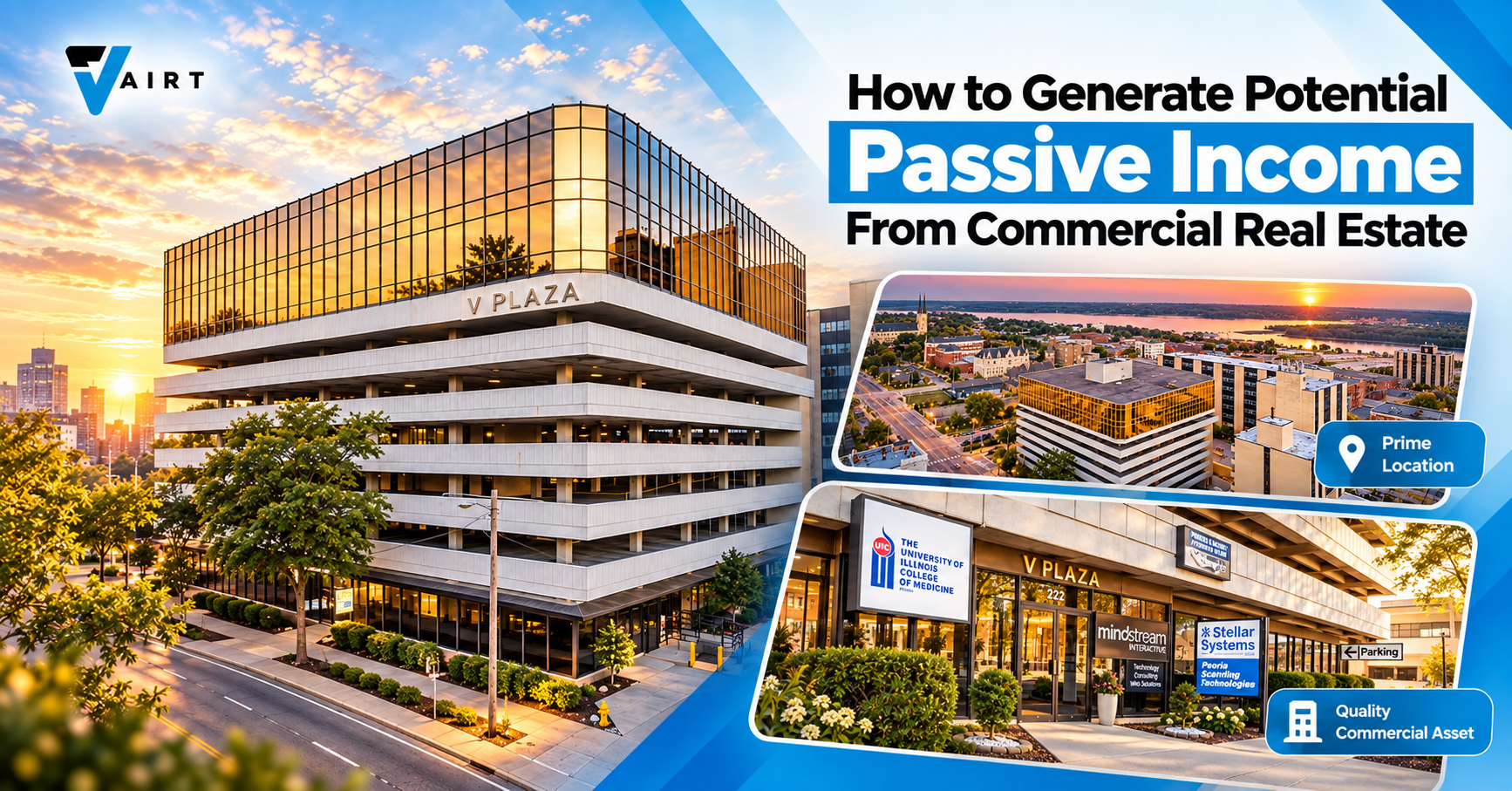
Four Points by Sheraton, downtown Peoria, Illinois: A 323-room, full-service hotel operating under a Marriott brand. Vairt describes it as fully renovated and positions it for both income and long-term appreciation potential.
Commercial office and parking property, downtown Peoria, Illinois: A 272,876-square-foot property combining stabilized office space with a large structured parking facility, providing two separate income streams.
V Resort Living, Sheridan, Illinois: A proposed residential resort redevelopment with 332 residences across approximately 165 acres, with an acquisition and rehabilitation plan designed to reposition and stabilize the property.
Econo Lodge Inn & Suites, Triadelphia, West Virginia: A 113-room hotel with planned improvements aimed at growing its income and value.
5 Million Star Hotel, Pennsylvania: A 60-unit hospitality development built around dome-style accommodations in a natural setting.
In each case, the work a landlord would normally do stays with the management team. You aren't screening tenants, managing hotel staff, or scheduling repairs. Your role is to review the property's details, decide whether to participate, and monitor updates.
Full property details, including projections, cost breakdowns, holding terms, and eligibility, are available to registered users. Creating a Vairt account takes a few minutes and lets you review each listing in depth. You can then compare Vairt's current real estate opportunities side by side.
Tired of the idea of tenants, repairs, and vacancies holding you back from real estate? Schedule a free 15-minute call and we'll walk you through how you can own part of a professionally managed property instead.
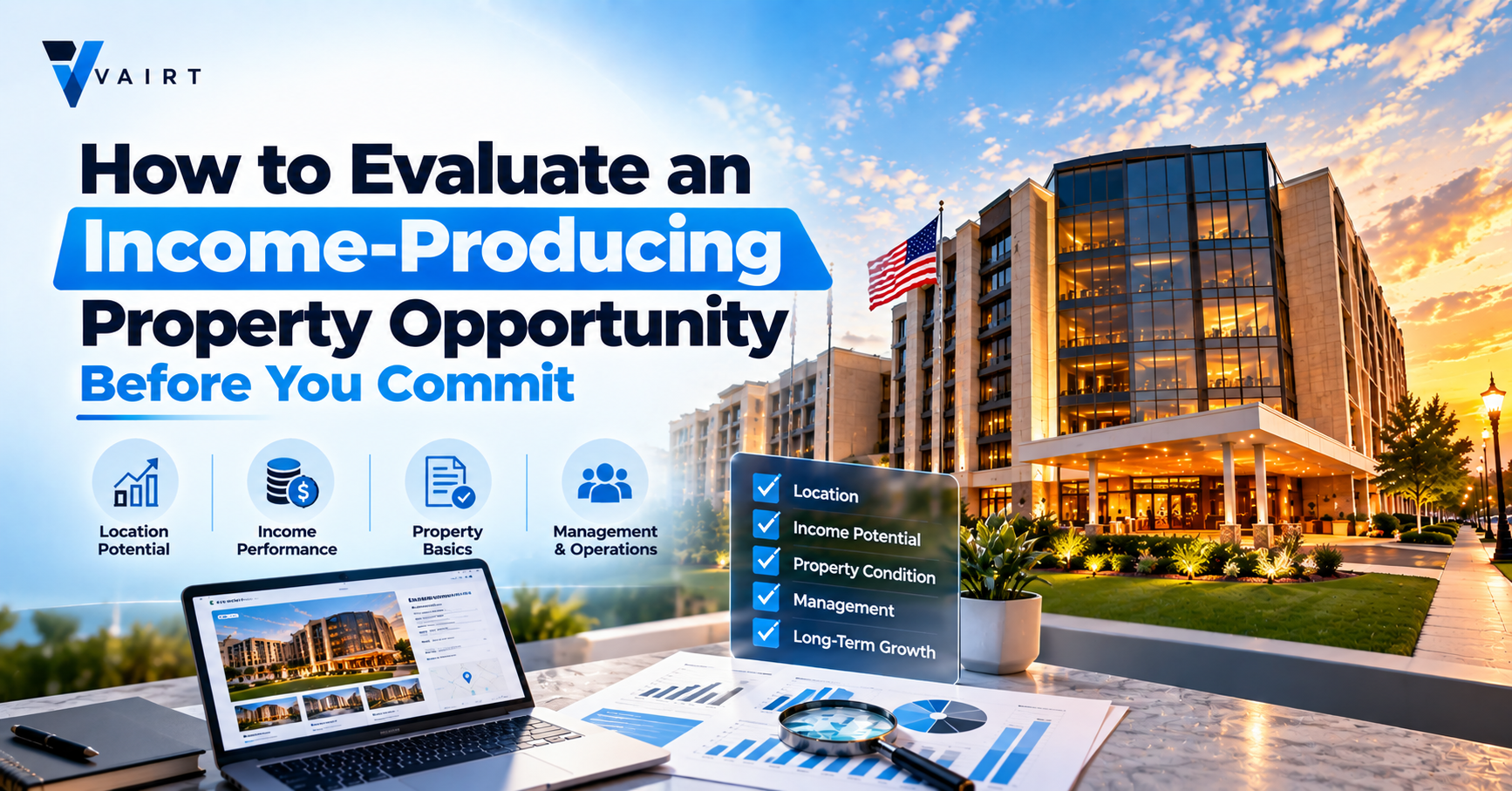
Every approach to making money from real estate is shaped by property-specific and market factors. Reviewing them is a normal part of due diligence:
Occupancy and demand: Rental income depends on keeping space leased, units rented, or rooms booked.
Operating expenses: Taxes, insurance, staffing, and maintenance affect how much income reaches owners.
Interest rates: Rates can influence financing costs and property valuations.
Location: Local employers, population trends, and new supply all influence demand. Our guide to the best cash flow real estate markets in the U.S shows how much location matters.
Renovation and construction plans: For value-add and development properties, the scope and timeline of planned work shape when income potential develops.
Holding period and liquidity: Direct property ownership is a long-term commitment, while publicly traded shares can be sold more easily.
The right way to make money through property depends on your goals:
REITs and real estate funds suit people who want broad exposure, low minimums, and the ability to sell anytime markets are open.
Crowdfunding and syndications suit people who want access to larger properties and are comfortable with longer holding periods.
Real estate lending suits people who prefer defined interest terms over ownership.
Fractional ownership suits people who want to own specific properties without managing them.
Fractional ownership on Vairt tends to fit people who:
Want real estate income potential without tenant, repair, or vacancy responsibilities
Want to own hotels, commercial buildings, or residential communities rather than a single rental
Prefer choosing specific properties over a broad portfolio
Are comfortable with a multi-year holding period
Other options may suit people who need short-term access to their money, want full control over property decisions, or prefer fixed income rather than income that follows property performance.
If tenant management, repairs, vacancies, or the cost of buying an entire property have kept you out of real estate, you have more options than ever. REITs, funds, crowdfunding, lending, and fractional ownership all let you earn from property without becoming a landlord.
If you want exposure to real, specific properties while professionals handle operations, fractional ownership offers a more direct property-level route. Review the property, the ownership structure, the income model, and the holding period, and then decide whether it fits your goals.
When you're ready to see what's available, explore Vairt's current real estate opportunities or create a Vairt account to review available property details.
You can make money through property without being a landlord by buying shares of publicly traded REITs, holding real estate funds, joining crowdfunded properties, lending to property owners, or owning a fractional share of a professionally managed property. In each case, someone else handles tenants, maintenance, and operations, while you choose where to put your capital and monitor performance.
For many people, publicly traded REITs are one of the easiest starting points because they can be bought through a regular brokerage account with a relatively small amount. If you want to own specific properties without managing them, fractional ownership platforms offer a hands-off route with property-level choice. The best option depends on your goals, budget, and timeline.
Yes. Passive income from property can come from approaches where a professional team or company handles operations, such as REITs, real estate funds, crowdfunding, and fractional ownership. Passive means you aren't doing the day-to-day work. Income still depends on property performance, occupancy, expenses, and market conditions, so it isn't guaranteed.
It depends on the approach. Publicly traded REIT shares can be bought for the price of a single share. Crowdfunding platforms range from a few hundred dollars to much larger minimums. Current U.S. opportunities on Vairt, including hotel, office, and residential properties, show minimum participation amounts starting at $25,000 on selected listings. Buying a rental property directly usually requires a much larger down payment.
Yes, but the exact legal structure matters. With Vairt's general fractional ownership model, participants hold ownership interests in a property-specific LLC or SPV that owns the underlying real estate. Your rights to income, sale proceeds, voting, and transfers are governed by the terms of the specific offering, so the relevant legal documents should be reviewed before participating.
No. Real estate income depends on occupancy, rents or room rates, operating expenses, interest rates, and local market conditions. Projected figures are estimates based on stated assumptions and are a helpful way to compare properties. Reviewing each property's details, structure, and holding period is part of making an informed decision.

I'm Muhammad Waqas, a real estate content writer at Vairt with 8 years of experience writing about property ownership and real estate. I cover topics such as fractional real estate, hotel and commercial property ownership, and how to evaluate income-producing properties. My writing focuses on helping U.S. readers understand how professionally managed real estate works, including its benefits, risks, and structure, before they explore an opportunity.

Certain statements contained in this document constitute forward-looking statements. Such forward-looking statements, including our intended actions and performance objectives, projections, targets, estimates, or forecasts involve known and unknown risks, uncertainties and other important factors, including our ability to successfully develop and operate the Vairt Marketplace, our business model and the services we intend to offer. These factors are based on expectations and assumptions that may change and are subject to regulatory uncertainty, changes in our legal environment and the blockchain and real estate industries generally, which could cause our actual results, performance or achievements to differ materially from any future results, performance or achievements expressed or implied by such forward-looking statements. All amounts, numbers, ranges, and values presented in this document are subject to material change and should be taken as preliminary and indicative only. Any such amounts, numbers, ranges, and values are based upon preliminary estimates, remain subject to ongoing analysis and may change materially. All forward-looking statements in this document speak only as of the date hereof. We expressly disclaim any obligation to update any forward-looking statement to reflect any change in our expectation or any change in events, conditions, assumptions or circumstances.


Comments