


A listing shows a hotel, an office building, or a rental property with an attractive projected yield. The photos look good. The numbers look better. But what's actually behind those figures?
That's the question most people struggle with when reviewing an income-producing property opportunity. Projections are built on assumptions about occupancy, rents, expenses, financing, and future value. If those assumptions are off, the income may be too.
The good news is that you don't need to be a commercial real estate professional to evaluate a property well. You need a clear framework and the right questions. This guide walks through both, using real examples from Vairt, a U.S.-focused platform offering professionally managed real estate opportunities.
Evaluating a property on your own can feel like a lot of questions at once. Schedule a free 15-minute call and we'll walk through a current Vairt property with you, from income sources and expenses to holding period and exit terms.
An income-producing property is real estate that generates recurring revenue from its operations, such as rent, hotel room revenue, lease payments, or parking fees. What owners may receive is the income left after the property pays its operating costs.
Common types of income-producing real estate include:
Residential rentals, such as single-family homes and apartment buildings
Hotels and hospitality properties, which earn revenue from nightly room stays and related services
Office buildings, which earn income from tenant leases
Parking facilities, which earn income from daily and monthly parking
Mixed-use and retail properties, which may combine several income streams
Each type earns money differently, which means each one should be evaluated differently. A hotel's income can change every night. An office building's income is usually tied to multi-year leases. That difference shapes almost every question that follows.
Most real estate property opportunities lead with a single figure: a projected yield, cash-on-cash return, or total return. These figures are useful starting points, but they are not conclusions.
Two properties can show the same projected figure for completely different reasons. One may assume steady occupancy in a proven market. Another may assume a renovation will finish on time and on budget, followed by rising rents. The second property may carry far more uncertainty.
Evaluating an opportunity means looking past the headline to understand the assumptions underneath it. The framework below breaks that process into clear steps.
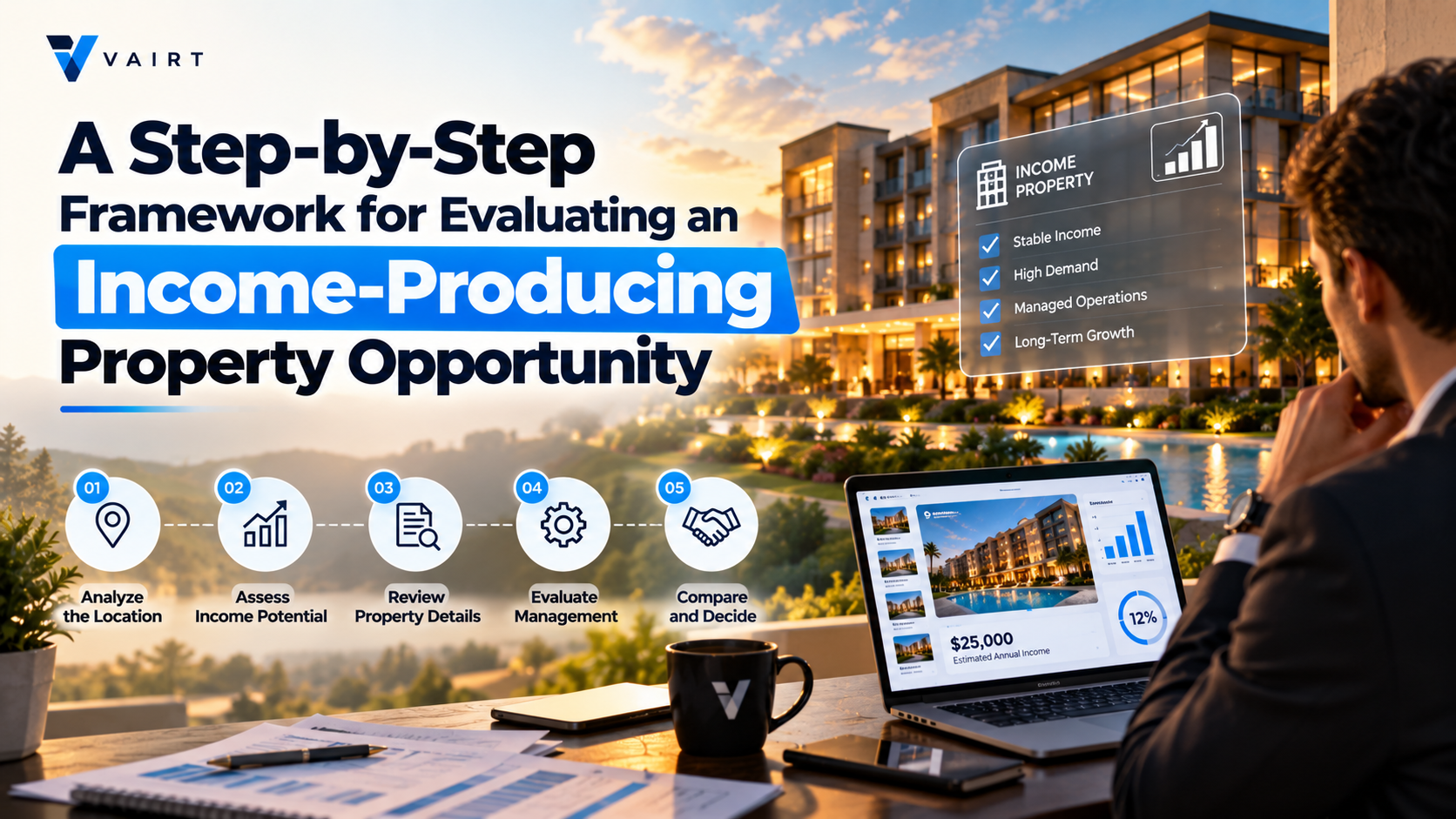
Income starts with demand. Before looking at any financial projection, ask why people would rent, stay at, or lease space in this specific property.
Look for:
Demand drivers, such as nearby employers, hospitals, universities, event venues, highways, or tourist attractions
Local market conditions, including competing properties and whether demand is growing or shrinking
Property condition, including age, recent renovations, and what upgrades may still be needed
Brand or reputation, particularly for hotels, where a recognized brand can influence bookings
A strong property in a weak market can struggle. A modest property in a location with steady demand can perform consistently.
Next, identify every source of revenue and how stable each one is.
A hotel's revenue depends on occupancy and room rates, which can shift with seasons, business travel, and events. An office building's revenue depends on lease terms, tenant quality, and how many leases expire soon. A property with multiple income streams, such as office space combined with parking, may be less exposed to a slowdown in any single source.
Ask: What happens to income if the largest revenue source drops by 10% or 20%? A well-prepared opportunity should be able to answer that.
Revenue is only half the picture. The income that matters is what remains after costs.
That figure is often called net operating income (NOI): the property's revenue minus its operating expenses, before loan payments and taxes on owners. NOI is one of the most useful numbers in commercial real estate because it shows what the property actually earns from operations.
Expenses to check include:
Property management and staffing
Maintenance and repairs
Insurance and property taxes
Utilities
Platform or sponsor fees
Loan payments, if the property uses financing
Reserves for future capital repairs, such as roofs, HVAC systems, or renovations
If a listing shows revenue but not expenses, ask for them. Missing expense detail is one of the easiest ways for projections to look better than reality.
Every projection rests on assumptions. Your job is to identify them and decide whether they seem reasonable.
Two common metrics are worth understanding:
Cash-on-cash return compares the annual cash an owner receives to the amount they put in. It reflects income, not appreciation.
Projected appreciation estimates how much the property's value may grow over the holding period. It is usually realized only at sale.
Then ask:
What occupancy or rent levels does the projection assume?
Are those assumptions in line with the property's history and local market?
Are figures shown before or after fees and property costs?
What holding period is the projection based on?
That third question matters more than many readers realize. Vairt, for example, states that the figures in its online calculator are shown before property costs and platform fees and are based on a five-year holding period. That kind of disclosure is useful. It tells you to look at the property-specific figures for net numbers rather than relying on a general estimate.
Many income-producing real estate opportunities include both a purchase price and a renovation budget. This is often called a value-add strategy: buy a property, improve it, and aim to increase its income and value.
Value-add strategies can create upside, but they add execution risk. Renovations can take longer or cost more than planned, and income may be lower while work is underway.
Look at how the total cost is split between acquisition and rehab. Vairt's listings break out these two figures separately, which makes it easier to see how much of the plan depends on improvements. Then ask who is managing the renovation and what the timeline is.
Evaluating a property on your own can feel like a lot of questions at once. Schedule a free 15-minute call and we'll walk through a current Vairt property with you, from income sources and expenses to holding period and exit terms.
Before committing, know exactly what you would own.
On many platforms, participants don't hold the property directly. Instead, they own shares in a property-specific LLC, a legal entity created to own one particular property. Participants own the LLC, and the LLC owns the real estate.
Vairt uses this model. After a property is fully funded, an LLC is formed for it in the relevant state and divided into one million shares, allocated in proportion to each participant's contribution. Funds are held in escrow while the property is being funded. If a property isn't fully funded within its 30-day listing window, Vairt says committed amounts are returned to the participant's digital wallet at no cost.
You can see the full process on Vairt's How It Works page.
In professionally managed real estate, results depend heavily on the operator. Owners aren't handling tenants, guests, repairs, or vendors, so someone else is, and their skill directly affects income.
Ask:
Who operates the property day to day?
What experience do they have with this property type?
How often will owners receive updates and financial reporting?
How is income distributed?
On Vairt, the management team handles maintenance and keeping the property tenanted, and owners can track income and property updates through Vairt's website and mobile app. Rental income is transferred to the owner's digital wallet, where it can be withdrawn or reinvested.
Income-producing real estate is usually a multi-year commitment. Understand how long you are expected to hold and how you can exit.
Vairt recommends a five-year holding period. Owners can list their shares on a secondary market or call a vote among owners to sell the entire property. Neither route guarantees a sale on a specific timeline or at a specific price, so plan around the full expected holding period.
Finally, check whether you are eligible to participate and read the documents that govern the property. These often include an operating agreement and property-specific disclosures.
Some listings on Vairt are limited to certain participant categories, so confirm eligibility on each property page. If anything in the documents is unclear, ask before committing, and consider speaking with a qualified financial or legal advisor.
A real example makes the framework easier to use.
The Four Points by Sheraton in downtown Peoria, Illinois is a 323-room, full-service hotel operating under a Marriott brand. Vairt describes the hotel as fully renovated, citing a $40 million renovation and a location that draws corporate and event-driven demand. The listed minimum to participate is $25,000.
Here's how the framework applies:
Location: What drives demand in downtown Peoria, and how consistent is corporate and event travel there?
Income source: Hotel revenue changes nightly, so review occupancy and rate assumptions closely.
Expenses: A full-service hotel has significant staffing and operating costs. Check how these are reflected in projected income.
Capital plan: How much of the renovation is complete, and what capital needs remain?
Management: Owners don't staff the hotel, manage bookings, or handle maintenance. Confirm who does and how performance is reported.
Exit: Compare the projections to Vairt's recommended five-year holding period.
A different property type raises different questions. Vairt's commercial office and parking property in downtown Peoria combines office space with a large structured parking facility. There, the focus shifts to lease terms, tenant stability, and parking demand.
You can compare both, along with Vairt's other current income-producing property opportunities, and apply the same questions to each.
Both paths require evaluation. The difference is how much of the groundwork you do yourself.
Buying a property directly means finding the deal, analyzing it, arranging financing, negotiating, closing, and then managing it or hiring a manager. Through a platform, much of the sourcing and screening happens before a property is listed.
Vairt describes screening each property with a 100-point proprietary tool and using a third-party valuator to support its assessment. You can read more about that on Vairt's property review process page.
Screening narrows the field, but it doesn't replace your own judgment. The best approach is to use the platform's work as a starting point and still apply the framework above to every property.
Professionally managed income-producing properties tend to fit people who:
Want real estate income potential without landlord responsibilities
Are interested in hotels or commercial properties but don't want to buy an entire building
Are comfortable holding for several years
Prefer reviewing property details over managing operations
Want to spread their capital across more than one property over time
They may not fit people who:
Need quick access to their money
Want full control over property decisions
Are uncomfortable with income that varies with property performance
Passive real estate is not risk-free real estate. "Passive" means you aren't doing the day-to-day operational work. The property still faces changes in occupancy, expenses, interest rates, local demand, and value.
If you'd like context on the team behind the platform, you can learn more about Vairt and its background.
Evaluating a property on your own can feel like a lot of questions at once. Schedule a free 15-minute call and we'll walk through a current Vairt property with you, from income sources and expenses to holding period and exit terms.
An income-producing property opportunity is only as good as the property, assumptions, structure, and team behind it. The headline figure is where evaluation begins, not where it ends.
Start with location and demand. Understand where the income comes from and what it costs to produce. Test the projections, review the capital plan, confirm the ownership structure, and know how and when you can exit. Professional management can take tenants, guests, repairs, and operations off your plate, but the decision to participate is still yours.
When you're ready to apply this framework to real properties, review Vairt's current opportunities and create an account to see the full property details.
An income-producing property opportunity is a chance to own all or part of real estate that generates recurring revenue, such as rent, hotel room revenue, lease payments, or parking fees. Owners may receive a share of the income left after operating costs, fees, and any loan payments. Income depends on property performance and is not guaranteed.
No single factor decides it, but demand is the foundation. A property needs a reliable reason for people to rent, stay, or lease space there. After demand, focus on net operating income, the assumptions behind projections, the management team's experience, and the holding period and exit terms. Together, these show whether the projected income is realistic.
NOI, or net operating income, is a property's revenue minus its operating expenses, before loan payments. It shows what the property actually earns from operations. NOI matters because gross revenue can look strong while high expenses leave little income for owners. Comparing NOI across properties gives a clearer picture than comparing revenue alone.
No. Income from real estate depends on occupancy, rents or room rates, operating expenses, financing costs, local market conditions, and management performance. Projected figures help you evaluate a property, but they are estimates based on assumptions. Property values can also decline, which affects what owners receive when the property is sold.
It depends on the platform and property. Minimums range widely across the industry, from a few hundred dollars to much larger amounts for commercial properties. Current listings on Vairt, including hotel and commercial properties, show a $25,000 minimum. Always confirm the minimum and any eligibility requirements on the specific property listing.
Review the property listing, projected financials and their assumptions, fee disclosures, the capital or renovation plan, and the operating agreement for the ownership entity. Look for details on income distributions, reporting, holding period, voting rights, and exit options. If something is unclear, ask the platform directly and consider consulting a qualified advisor.
Most income-producing property opportunities are designed as multi-year holds. Vairt recommends a five-year holding period. Owners may be able to exit earlier, for example by selling shares on a secondary market or through an owner vote to sell the property, but early exits depend on buyer demand and market conditions and are not guaranteed.

Hassan is a financial writer at Vairt, specializing in halal investing and ethical wealth management. He simplifies complex financial topics to help Muslim investors explore Shariah-compliant opportunities in real estate, stocks, gold, and more. His goal is to empower readers with clear, practical insights for confident and long-term wealth building.

Certain statements contained in this document constitute forward-looking statements. Such forward-looking statements, including our intended actions and performance objectives, projections, targets, estimates, or forecasts involve known and unknown risks, uncertainties and other important factors, including our ability to successfully develop and operate the Vairt Marketplace, our business model and the services we intend to offer. These factors are based on expectations and assumptions that may change and are subject to regulatory uncertainty, changes in our legal environment and the blockchain and real estate industries generally, which could cause our actual results, performance or achievements to differ materially from any future results, performance or achievements expressed or implied by such forward-looking statements. All amounts, numbers, ranges, and values presented in this document are subject to material change and should be taken as preliminary and indicative only. Any such amounts, numbers, ranges, and values are based upon preliminary estimates, remain subject to ongoing analysis and may change materially. All forward-looking statements in this document speak only as of the date hereof. We expressly disclaim any obligation to update any forward-looking statement to reflect any change in our expectation or any change in events, conditions, assumptions or circumstances.


Comments