


Hotels, office buildings, and large residential communities can produce meaningful income, but buying one usually takes millions of dollars, financing, and a team to run it. For most people, commercial real estate has been out of reach.
Commercial property crowdfunding changes that. By pooling funds from many participants online, it lets you own part of a commercial property without buying the whole building or handling day-to-day operations.
That doesn't mean it's the right fit for everyone. Commercial property crowdfunding comes with multi-year holding periods, eligibility rules, and income that follows property performance. This guide explains how it works, which U.S. rules apply, and the questions to ask yourself before participating. It also shows how Vairt, a real estate platform offering professionally managed real estate opportunities, structures access to commercial property ownership.
Commercial property crowdfunding is a way for many people to pool money online to acquire or finance a commercial property, such as a hotel, office building, parking facility, or residential community. In equity-based models, each participant holds an ownership interest based on the structure of the offering and their contribution.
There are two main types:
Equity crowdfunding: Participants own a share of the property, usually through a legal entity such as an LLC. They may receive a share of rental income and any appreciation when the property is sold.
Debt crowdfunding: Participants lend money to a property owner or sponsor and receive interest payments under the loan's terms. They don't own the property itself.
Equity-based commercial property crowdfunding is closely related to fractional commercial real estate, where each participant owns a proportional interest in a specific property or the entity that holds it. You can learn more in Vairt's guide on how partial property ownership works with real estate platforms. That's the model this guide focuses on.
See how Vairt can help you access fractional real estate opportunities. Schedule a 15-minute meeting to discuss how it works.
Most commercial property crowdfunding platforms follow a similar sequence:
The platform sources and screens properties. Its team reviews location, financials, and market conditions before listing anything.
You review the listing. Each property shows its type, location, projected figures, costs, and terms.
Participants commit funds. Commitments are collected online during a set funding period.
The property is acquired. Once fully funded, the property is acquired according to the legal ownership structure described in the offering documents, and participants receive their corresponding ownership interests.
Professional management runs it. An operating team handles leasing, guests, maintenance, and reporting.
Income is distributed. Owners receive their share of distributable income based on property performance.
The property is held, then sold. After the holding period, the property may be sold or owners may exit according to the platform's and specific offering's terms.
The appeal is simple. Instead of buy, finance, lease, manage, repair, and sell, your role becomes review, choose, own, and monitor. For a closer look at this hands-off model, read Vairt's guide to earning passive income from real estate without becoming a landlord.
In the U.S., commercial property crowdfunding offerings generally rely on securities rules set by the SEC. The three frameworks you'll see most often are Regulation Crowdfunding, Regulation D, and Regulation A.
Regulation Crowdfunding (Reg CF) allows broad participation, with guardrails. Under the SEC's rules, all transactions must take place online through an SEC-registered intermediary, either a broker-dealer or a funding portal, and a company can raise a maximum of $5 million through crowdfunding offerings in a 12-month period.
Reg CF also limits how much non-accredited individuals can put into crowdfunding offerings each year. If either annual income or net worth is below $124,000, the limit is generally the greater of $2,500 or 5% of the greater of annual income or net worth. If both are at least $124,000, the limit is generally 10% of the greater of annual income or net worth, subject to an aggregate cap of $124,000 across Reg CF offerings in a 12-month period. Securities bought this way generally cannot be resold for one year.
Regulation D offerings are often limited to accredited participants. Under the SEC's definition, individuals can generally qualify through financial criteria such as more than $200,000 in annual individual income, more than $300,000 in joint income with a spouse or partner, or more than $1 million in net worth excluding their primary residence. Certain professional qualifications can also qualify an individual as accredited.
Regulation A supports larger offerings. Tier 2 offerings can raise up to $75 million in a 12-month period.
Which framework applies affects who can participate, how much they can put in, and what disclosures they receive. That's why eligibility requirements differ from one listing to the next.
They overlap, but they aren't always the same.
Both can pool capital from many people to access commercial property. The difference is in what you hold. Some crowdfunding platforms offer shares in a fund that owns many properties, or loans to sponsors. Fractional ownership platforms typically give you an interest connected to one specific property through the ownership structure described in the offering.
Vairt generally structures fractional ownership opportunities through property-specific investment vehicles such as LLCs or SPVs. The exact ownership structure and rights can vary by offering, so the legal documents for each property should be reviewed before participating. You can read more about this structure in our guide on how partial property ownership works with real estate platforms.
Commercial property crowdfunding tends to be a good fit if you can answer "yes" to most of the questions below. Each one reflects a real feature of how these properties work.
Commercial real estate is a long-term asset. Most crowdfunded properties are designed to be held for several years so income and potential appreciation have time to develop. Vairt, for example, recommends a five-year holding period. If you may need the money in the next year or two, other options may suit you better.
You can see how Vairt's ownership process works on its How It Works page.
This is where crowdfunding stands out. You don't screen tenants, schedule repairs, manage staff, or handle guests. A professional team does that work. If you'd rather review properties than operate them, the model fits well.
Passive doesn't mean risk-free, though. It means you aren't responsible for daily operations. The property's results still depend on occupancy, expenses, and market conditions. Our guide to commercial real estate passive income explains this distinction in more detail.
Equity crowdfunding income isn't fixed. It rises and falls with how the property performs. Projected figures help you compare properties, but they are estimates. If you need fixed, predictable payments, this structure may not match your goals.
Minimums vary widely. Some platforms start at a few hundred dollars, while commercial properties often require more. Current U.S. opportunities on Vairt show minimum participation amounts starting at $25,000 on selected listings. Ideally, the amount you commit should be money you can leave in place for the full holding period.
You can compare minimums and property types on Vairt's current real estate opportunities.
Some offerings are open to a broad range of participants, while others are limited to accredited individuals or specific participant categories. Check the eligibility requirements and legal documents on each property before committing.
If you prefer knowing exactly which hotel, office building, or residential community your ownership is connected to, property-specific crowdfunding can be a strong match. If you'd rather hold a broad mix chosen for you, a fund-based approach may fit better.
For guidance on choosing individual properties, see our breakdown of the best fractional ownership properties and what to look for.
Once you've decided the model fits, the platform matters. A strong commercial property crowdfunding platform should give you clear answers to these questions:
How are properties screened? Look for a defined review process and independent valuation.
What exactly do you own? The ownership structure should be clearly defined in the property's legal documents.
What happens to your money during funding? Understand where funds are held and what happens if the funding target isn't reached.
How transparent are projections and fees? You should be able to see the assumptions and whether figures are shown before or after costs.
Who manages the property? The operating team's experience matters.
How is income distributed and reported? Look for regular updates and easy tracking.
What are the exit options? Understand the holding period, liquidity restrictions, and how an eventual sale or transfer may work.
Here's how Vairt addresses these questions:
Each property is evaluated using Vairt's screening and review process, supported by third-party analysis. You can read more on Vairt's property review process page.
Properties are generally listed for a funding period, with participant funds held in escrow. Vairt states that if a property does not reach its funding target within the applicable period, committed amounts are returned according to its platform process.
Vairt generally structures fractional ownership opportunities through a property-specific LLC or SPV, with ownership interests allocated according to the structure of the individual offering.
The management team handles maintenance and occupancy, while owners can monitor their properties and activity online.
Owners can track updates through Vairt's website and mobile app.
Potential exit options may include selling ownership interests or an owner vote to sell the property, subject to the specific offering terms, applicable restrictions, buyer demand, and available liquidity options.
Schedule a 15-minute meeting with the Vairt team to discuss the property, ownership structure, and how the process works.
Current listings show the range of commercial property types available through this model. Selected U.S. opportunities currently show a $25,000 minimum.
Four Points by Sheraton, downtown Peoria, Illinois: A 323-room, full-service hotel operating under a Marriott brand, described by Vairt as fully renovated and positioned for both income and long-term appreciation potential.
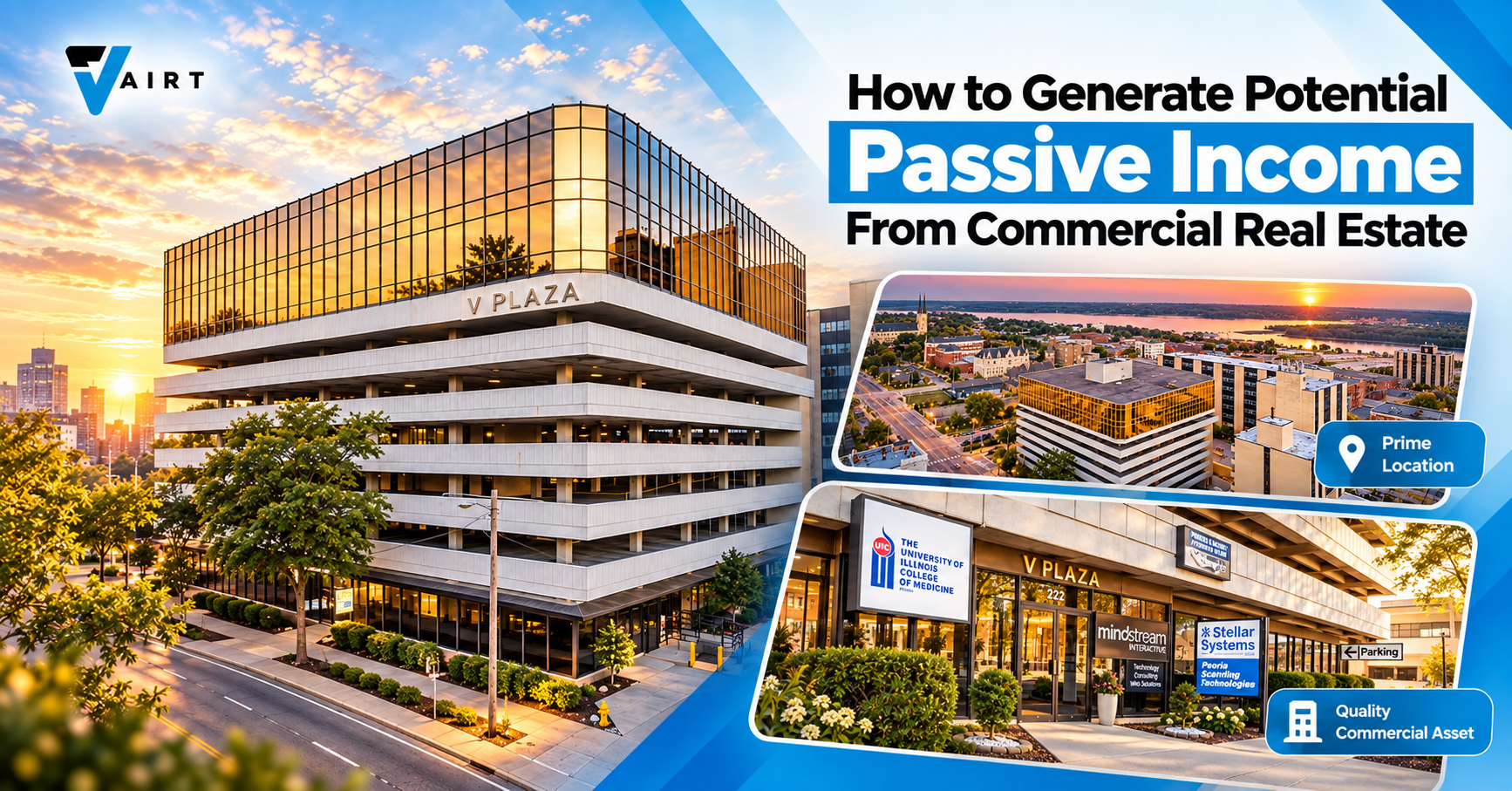
Commercial office and parking property, downtown Peoria, Illinois: A 272,876-square-foot property combining stabilized office space with a large structured parking facility, providing two separate income streams.
V Resort Living, Sheridan, Illinois: A proposed resort-style residential redevelopment with 332 residences across approximately 165 acres. The project includes acquisition and rehabilitation, with potential income expected as the property is renovated, repositioned, and operationally stabilized.
Econo Lodge Inn & Suites, Triadelphia, West Virginia: A 113-room hotel with planned improvements aimed at growing its income and value.
5 Million Star Hotel, Pennsylvania: A 60-unit hospitality development built around dome-style accommodations in a natural setting.
In every case, the operational work is intended to remain with the management team. As an owner, you aren't negotiating leases, running a hotel, or maintaining grounds yourself.
Full property details, including projections, cost breakdowns, holding terms, and eligibility, are available through the platform. Creating a Vairt account lets you review available listing details before making a decision. You can then compare Vairt's current commercial property opportunities side by side.
Still deciding whether commercial property crowdfunding fits your goals? Schedule a free 15-minute call and we'll walk you through how Vairt works and which current properties match what you're looking for.
Every commercial property is shaped by property-specific and market factors. Reviewing them is a normal part of due diligence:
Occupancy and demand: Income depends on keeping space leased, units rented, or rooms booked.
Operating expenses: Taxes, insurance, staffing, and maintenance affect how much income reaches owners.
Interest rates: Rates can influence financing costs and property valuations.
Local market conditions: Employers, population trends, and new supply all influence demand.
Renovation and construction plans: For value-add and development properties, the scope and timeline of planned work shape when income potential develops.
Holding period and liquidity: Real estate is a long-term asset, and any early exit depends on the offering terms, applicable restrictions, buyer demand, and available liquidity.
If the cost of buying a commercial property, or the work of running one, has kept you out of commercial real estate, commercial property crowdfunding offers another route. You can own part of a professionally managed hotel, office building, or residential community while an operating team handles the day-to-day work.
It fits best if you're comfortable with a multi-year holding period, income that follows property performance, and the platform's eligibility rules. Review each property's location, income model, ownership structure, fees, and exit terms, and then decide whether it matches your goals.
When you're ready to see real properties, explore Vairt's current real estate opportunities or create a Vairt account to review available listing details.
Commercial property crowdfunding is a way for many participants to pool money online to acquire or finance a commercial property, such as a hotel, office building, or residential community. In equity crowdfunding, each participant owns an interest based on the offering's legal structure and may receive a share of income and appreciation. In debt crowdfunding, participants lend money and receive interest instead.
It can be legitimate when an offering is structured under applicable U.S. securities laws and offered through the required channels. Common frameworks include Regulation Crowdfunding, Regulation D, and Regulation A, each with its own disclosure and eligibility requirements. Before participating, review the platform's screening process, ownership structure, fee disclosures, team, and the legal documents for the specific property.
Minimums vary by platform and property. Some platforms start at a few hundred dollars, while commercial properties often require more. Selected current U.S. opportunities on Vairt show a $25,000 minimum. Always confirm the minimum and eligibility on the specific property listing.
Often, yes, depending on the offering and securities exemption used. Regulation Crowdfunding offerings can be open to non-accredited participants, subject to annual investment limits. Some Regulation D offerings are limited to accredited investors. Always check the eligibility requirements for the specific offering before participating.
It depends on the offering, applicable securities rules, and the platform's terms. Securities bought under Regulation Crowdfunding generally cannot be resold for one year, subject to certain exceptions. For Vairt properties, potential exit options may include transferring or selling ownership interests or an owner vote to sell the property, subject to the offering terms, applicable restrictions, buyer demand, and available liquidity.
No. In equity crowdfunding, income depends on occupancy, rents or room rates, operating expenses, interest rates, and local market conditions. Projected figures are estimates based on stated assumptions and are a helpful way to compare properties. Reviewing each property's details and holding period is part of making an informed decision.
With commercial property crowdfunding, you typically choose a specific property or offering and own an interest connected to that asset according to its legal structure. With a REIT, you own shares of a company that holds a portfolio of properties chosen by its managers, and publicly traded REIT shares can usually be sold on an exchange. Crowdfunding can offer more property-level choice, while public REITs generally offer easier liquidity.

I'm Muhammad Waqas, a real estate content writer at Vairt with 8 years of experience writing about property ownership and real estate. I cover topics such as fractional real estate, hotel and commercial property ownership, and how to evaluate income-producing properties. My writing focuses on helping U.S. readers understand how professionally managed real estate works, including its benefits, risks, and structure, before they explore an opportunity.

Certain statements contained in this document constitute forward-looking statements. Such forward-looking statements, including our intended actions and performance objectives, projections, targets, estimates, or forecasts involve known and unknown risks, uncertainties and other important factors, including our ability to successfully develop and operate the Vairt Marketplace, our business model and the services we intend to offer. These factors are based on expectations and assumptions that may change and are subject to regulatory uncertainty, changes in our legal environment and the blockchain and real estate industries generally, which could cause our actual results, performance or achievements to differ materially from any future results, performance or achievements expressed or implied by such forward-looking statements. All amounts, numbers, ranges, and values presented in this document are subject to material change and should be taken as preliminary and indicative only. Any such amounts, numbers, ranges, and values are based upon preliminary estimates, remain subject to ongoing analysis and may change materially. All forward-looking statements in this document speak only as of the date hereof. We expressly disclaim any obligation to update any forward-looking statement to reflect any change in our expectation or any change in events, conditions, assumptions or circumstances.
Comments