



Finding real estate that produces positive cash flow is harder than it used to be. Home prices are high, and in many parts of the country, rents haven't kept pace with what properties cost to buy.
But cash flow hasn't disappeared. It has moved. The best cash flow real estate markets in 2026 are concentrated in the Midwest and parts of the South, where property prices remain reasonable relative to rents.
Finding the right market is only half the challenge, though. Owning and managing property in a city you don't live in comes with its own problems. This guide covers where the strongest cash flow markets are, what makes them work, and how professionally managed fractional ownership, including properties Vairt offers in one of the top-ranked markets, lets you participate without becoming a long-distance landlord.
Find cash-flow-focused real estate opportunities in top markets without becoming a long-distance landlord. Schedule a free 15-minute call to explore Vairt’s professionally managed fractional properties.
The best cash flow real estate markets in 2026 are mostly in the Midwest and select Southern metros. According to ATTOM's 2026 Single-Family Rental Market report, the counties with the highest potential rental yields in 2026 were Saint Clair County, IL (14.5%), Mobile County, AL (13.6%), Peoria County, IL (12.5%), Saint Louis County, MN (11.6%), and Trumbull County, OH (11.5%).
Other markets that consistently appear in 2026 cash flow rankings include Cleveland, Toledo, Indianapolis, Kansas City, and Columbus. What these markets share is affordable property prices relative to local rents, steady employment, and housing costs that remain within reach for local renters.

Cash flow is the money a property produces after its expenses are paid. If a property collects more in rent than it costs to operate and finance, it has positive cash flow.
A few related terms help when comparing markets:
Gross rental yield is a property's annual rent divided by its purchase price. It's a quick way to compare markets, but it doesn't account for expenses.
Net operating income (NOI) is revenue minus operating expenses, such as taxes, insurance, maintenance, and management, before loan payments.
Cash-on-cash return compares the annual cash an owner receives to the amount of cash they put in.
Cap rate compares a property's net operating income with its value or purchase price and is commonly used to compare income-producing properties.
Market rankings usually use gross yield because it's easy to calculate across many locations. For an individual property, net figures matter more, since property taxes, insurance, and operating costs vary widely from one market to another.
Cash flow is under pressure in much of the country because property prices have risen faster than rents in many areas. ATTOM found that rental yields declined from 2025 to 2026 in 54.8% of the 341 counties with sufficient data to analyze for both years.
ATTOM's CEO explained that many landlords have offset higher acquisition costs with rent growth, but record-high home prices are compressing yields in most counties.
The gap between markets is wide. At the low end, Santa Clara, California, reported the lowest rental yield at 3.1%, tied with Walton, Florida. That's why so many owners focused on income are looking beyond the coasts.
If your goal is income without taking on the full workload of direct ownership, it also helps to understand how passive income from real estate can work without becoming a landlord.

These markets stand out for cash flow potential in 2026, based on current rental yield data and market analysis.
Peoria is one of the strongest cash flow markets in the country this year. ATTOM expects Peoria County, Ill., to see rental yields of 12.5%, ranking it third-highest among the counties analyzed.
Peoria combines affordable property values with steady rental demand, a mix that supports income-producing real estate. It's also home to two of Vairt's current properties, which we cover below.
Located in the Illinois portion of the St. Louis metro area, Saint Clair County, Ill., is projected to reach single-family rental yields of 14.5% in 2026, the highest in ATTOM's analysis. Its appeal comes from low property prices relative to rents within a large metro area.
3. Mobile, Alabama
Mobile is the South's top performer on yield, with projected single-family rental yields of 13.6%. It also appears among ATTOM's 18 counties where wage growth coincided with potential rental yields above 10%, a combination that suggests renters' incomes are keeping up with housing costs.
Cleveland is a regular at the top of cash flow lists. Landlord Studio calls it the leading cash flow market for 2026, citing the highest rent yield ratio and best affordability of any major US metro. Among very large counties, ATTOM projects Cuyahoga County, Ohio, at 9.5%.
Toledo's Lucas County is another of ATTOM's "SFR Growth" counties, where 2026 rental yields exceeded 10% and wages grew year-over-year. The pairing of strong yields with rising wages makes it a market worth watching.
Indianapolis is known for balancing cash flow with rent growth. The Yardi Matrix July 2026 Single-Family Rental National Report identifies Indianapolis as leading the nation with 4.1% year-over-year rent growth. Market analysts also point to its affordability and landlord-friendly laws.
Kansas City offers a mix of cash flow and long-term growth potential. According to Landlord Studio, Kansas City delivered the strongest appreciation among Midwest markets while maintaining exceptional affordability.
Columbus is often viewed as a middle ground for owners who want both income and growth. Landlord Studio notes that Columbus strikes the balance between immediate cash flow and appreciation potential.
Discover cash-flow-focused real estate markets like Peoria and other high-potential U.S. markets. Schedule a free 15-minute call to explore Vairt’s professionally managed fractional properties.
The best cash flow real estate markets tend to share a handful of traits:
Favorable price-to-rent ratios: Properties cost less relative to the rent they can generate.
Wage growth: When local incomes rise, renters can support steady or growing rents.
Diverse employers: Healthcare, education, logistics, and manufacturing employers support consistent demand.
Balanced supply: Markets without a flood of new construction tend to keep occupancy steady.
Manageable operating costs: Property taxes and insurance vary by state and county, so net income can differ even between markets with similar gross yields.
ATTOM's "SFR Growth" designation captures two of these traits at once. It highlights counties where average wages grew over the past year and potential 2026 rental yields exceeded 10 percent.
The yield data above comes from single-family rentals, but the same market fundamentals shape other income-producing property markets.
Hotels, office buildings, parking facilities, and residential communities in affordable markets often have lower acquisition costs relative to the income they can produce. Demand drivers like local employers, hospitals, universities, event venues, and highway access support occupancy across property types.
The difference is in how each property type earns income. Hotels earn nightly room revenue that adjusts with travel demand. Office properties earn rent from business tenants under multi-year leases. Residential communities earn rent from many individual residents. When reviewing commercial real estate cash flow markets, look at both the market fundamentals and the specific property's income model.
If commercial properties are part of your strategy, our guide to generating potential passive income from commercial real estate explains these income models in more detail.
Most people who want exposure to high cash flow real estate markets don't live in them. Someone in California or New York may see strong yields in Peoria or Cleveland, but owning property there directly means:
Finding and evaluating deals in an unfamiliar market
Building a local team of agents, property managers, and contractors
Handling tenant screening, vacancies, and turnover from a distance
Managing repairs and maintenance through people you can't easily oversee
Tying up a large amount of capital in a single property
For many owners, the distance and the time required are what make cash flow markets impractical. This is one reason some buyers explore real estate ownership without becoming a traditional landlord.
You can access cash flow real estate opportunities through professionally managed fractional ownership. Instead of buying an entire property, you own a share of the entity that holds it, and a professional team handles operations on site.
Here's how that works on Vairt:
Each property is screened with a 100-point proprietary tool and supported by third-party analysis. You can learn more about Vairt's property review process.
Properties are listed for 30 days, with funds held in escrow. If a property isn't fully funded, committed amounts are returned to the participant's digital wallet at no cost.
Vairt generally structures fractional ownership opportunities through a property-specific LLC or SPV. The platform describes these entities as divided into one million shares, with ownership interests allocated according to each participant's contribution.
The management team handles maintenance and occupancy, and rental income is transferred to each owner's digital wallet.
Owners track updates through Vairt's website and mobile app.
You can see each step on Vairt's How It Works page, or read our guide on how partial property ownership works with real estate platforms.
This approach doesn't change the property's market fundamentals. It changes your role. Instead of managing tenants in a distant city, you review properties, choose the ones that fit your goals, and monitor performance.
Peoria's position near the top of the 2026 rental yield rankings makes Vairt's current listings there especially relevant. Both list a $25,000 minimum.
Four Points by Sheraton, downtown Peoria: A 323-room, full-service hotel operating under a Marriott brand. Vairt describes it as fully renovated and positions it for both income potential and long-term appreciation potential.
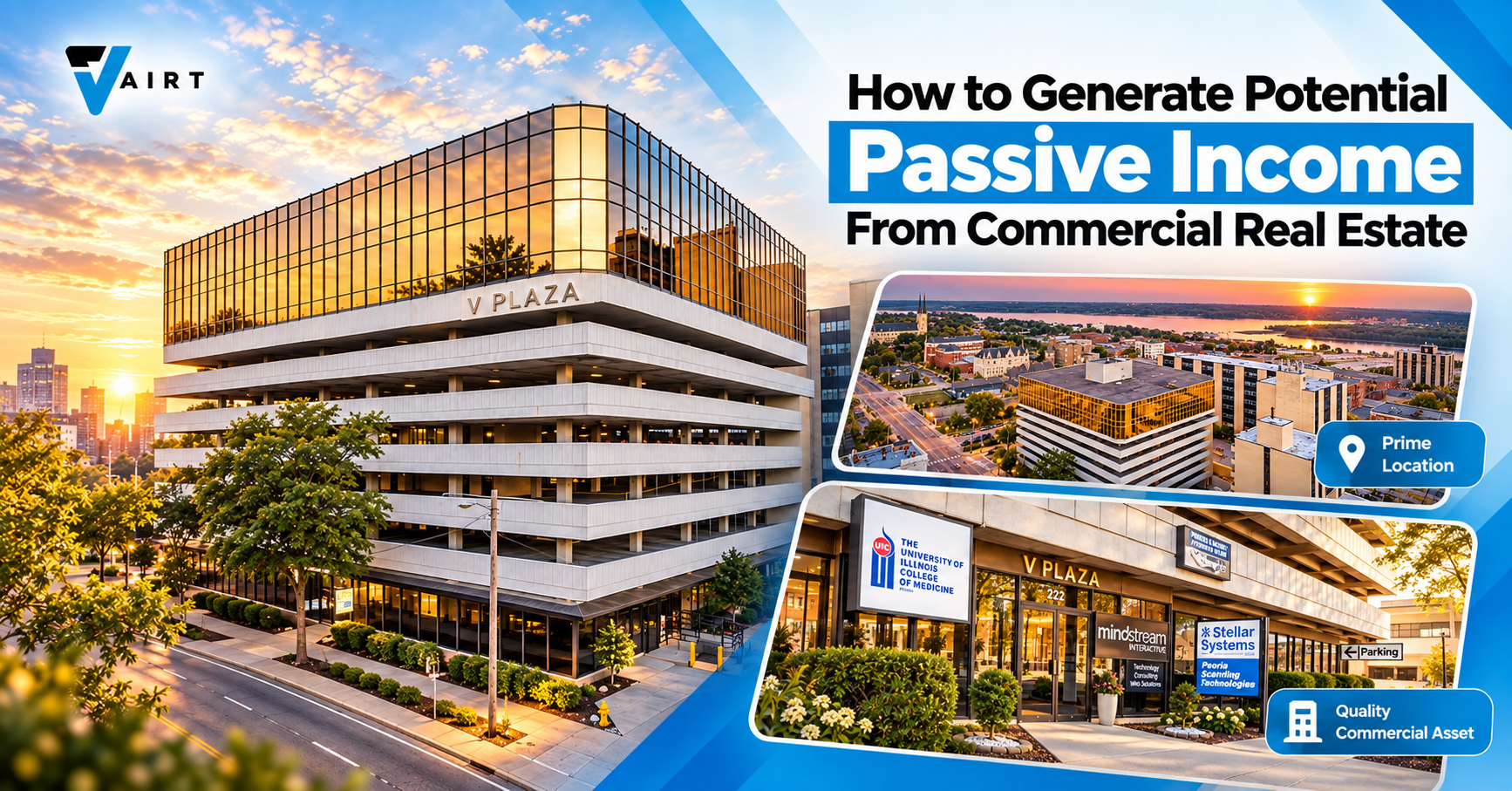
Commercial office and parking property, downtown Peoria: A 272,876-square-foot property combining stabilized office space with a large structured parking facility, with two separate income streams.
These are commercial and hospitality properties, so their performance depends on their own income models rather than single-family rental yields. But they sit in a market where affordable property values and steady demand are recognized strengths.
Vairt's other U.S. listings include opportunities such as V Resort Living, a 332-residence community in Sheridan, Illinois. You can compare Vairt's current real estate opportunities side by side.
Full property details, including projections, cost breakdowns, holding terms, and eligibility, are available to registered users. Creating a Vairt account takes a few minutes and lets you review every listing in depth before making any decision.
Want to own property in high cash flow markets without managing it from a distance? Schedule a free 15-minute call and we'll walk you through Vairt's current properties in Peoria and other Midwest markets.

Even in strong markets, each property should be reviewed on its own merits. Key factors include:
Market yields change: Rankings shift year to year as prices and rents move, so current data matters.
Gross vs. net figures: Gross yields don't include taxes, insurance, and operating costs, which vary by location.
Occupancy and demand: Income depends on keeping space leased, units rented, or rooms booked.
Interest rates: Rates can influence financing costs and property valuations.
Renovation plans: For value-add properties, the scope and timeline of improvements shape when income potential develops.
Holding period and liquidity: Vairt recommends a five-year holding period. Potential exit options may include selling ownership interests or an owner vote to sell the property, subject to offering terms and available liquidity options.
For a full framework, read our guide on how to evaluate an income-producing property opportunity before you commit. You can also learn how Vairt evaluates properties on its property review process page.
Professionally managed ownership in cash flow markets tends to fit people who:
Want exposure to high-yield Midwest markets without living there
Prefer not to manage tenants, contractors, or vacancies from a distance
Want access to hotels and commercial properties, not just single-family homes
Are comfortable with a multi-year holding period
Want to spread capital across several properties and property types
If diversification across properties is part of your goal, our guide on building a passive income portfolio with fractional real estate explains how different property types, locations, and holding periods can fit together.
Other options may suit people who:
Want to personally manage properties and control every decision
Need short-term access to their money
Prefer fixed, predictable income rather than income that follows property performance
The best cash flow real estate markets in 2026 are in places like Peoria, St. Clair County, Mobile, Cleveland, and Indianapolis, where property prices remain reasonable relative to rents. The challenge for most people is owning property in those markets without moving there or becoming a long-distance landlord.
Professionally managed fractional ownership offers another route. You hold a share of a specific property while an operating team handles tenants, guests, maintenance, and day-to-day operations. Review the market, the property's income model, the ownership structure, and the holding period, and then decide which property fits your goals.
When you're ready to look at real properties in these markets, explore Vairt's current real estate opportunities or create a Vairt account to unlock full details for current listings.
The best cash flow real estate markets in 2026 are mostly in the Midwest and select Southern metros. ATTOM's 2026 report ranked St. Clair County, Illinois; Mobile County, Alabama; and Peoria County, Illinois, as the top three counties for potential rental yields. Cleveland, Toledo, Indianapolis, Kansas City, and Columbus also rank well for their affordability and rental demand.
Midwest markets generally have lower property prices relative to local rents. That means each dollar spent on property can produce more rental income than in high-cost coastal markets, where prices have climbed far faster than rents. Many Midwest cities also have stable employers in healthcare, education, and manufacturing that support steady rental demand.
No. Gross rental yield is annual rent divided by purchase price, and it doesn't include expenses. Cash flow is what remains after operating costs, such as taxes, insurance, maintenance, and management, plus any loan payments. Two markets with similar gross yields can produce very different cash flow if their tax or insurance costs differ.
Yes. Professionally managed fractional ownership lets you own a share of a property in a cash flow market while an on-site team handles operations. On Vairt, for example, participants can access properties in Peoria, Illinois, without managing tenants, guests, or repairs themselves.
No. Cash flow depends on occupancy, rents or room rates, operating expenses, interest rates, and local market conditions. Market rankings and projected figures are helpful for comparing options, but they reflect current conditions and assumptions. Reviewing each property's details, structure, and holding period is part of making an informed decision.
Buying a property directly typically requires a down payment plus closing costs and reserves. Fractional ownership can lower the entry point compared with purchasing an entire property. Current U.S. listings on Vairt, including properties in Peoria, Illinois, show a $25,000 minimum. Always confirm the minimum and eligibility on the specific property listing.

I'm Muhammad Waqas, a real estate content writer at Vairt with 8 years of experience writing about property ownership and real estate. I cover topics such as fractional real estate, hotel and commercial property ownership, and how to evaluate income-producing properties. My writing focuses on helping U.S. readers understand how professionally managed real estate works, including its benefits, risks, and structure, before they explore an opportunity.

Certain statements contained in this document constitute forward-looking statements. Such forward-looking statements, including our intended actions and performance objectives, projections, targets, estimates, or forecasts involve known and unknown risks, uncertainties and other important factors, including our ability to successfully develop and operate the Vairt Marketplace, our business model and the services we intend to offer. These factors are based on expectations and assumptions that may change and are subject to regulatory uncertainty, changes in our legal environment and the blockchain and real estate industries generally, which could cause our actual results, performance or achievements to differ materially from any future results, performance or achievements expressed or implied by such forward-looking statements. All amounts, numbers, ranges, and values presented in this document are subject to material change and should be taken as preliminary and indicative only. Any such amounts, numbers, ranges, and values are based upon preliminary estimates, remain subject to ongoing analysis and may change materially. All forward-looking statements in this document speak only as of the date hereof. We expressly disclaim any obligation to update any forward-looking statement to reflect any change in our expectation or any change in events, conditions, assumptions or circumstances.



Comments