

.jpg)
Buying commercial property can be one of the most rewarding ways to own real estate. Office buildings, hotels, and residential communities can produce steady income and grow in value over time. But commercial property is also a much bigger undertaking than buying a home or a single rental.
There are many things to consider when buying commercial property, from location and tenant leases to financing, zoning, and long-term management. Getting any one of them wrong can be costly, and getting all of them right takes time, capital, and expertise most people don’t have.
This guide walks through the 10 most important things to consider before buying commercial property. It also explains how professionally managed fractional ownership, offered by platforms like Vairt, lets you own part of a commercial property while an experienced team handles much of this work for you.
Before buying commercial property, you should consider your goals, the property type, location, physical condition, income and expenses, tenant leases, financing, zoning, management, total costs, and your exit plan. Each of these affects how much income the property can produce and how much work ownership will require.
The sections below explain each one in plain terms, so you know what to look for and which questions to ask.
Thinking about buying commercial property but not sure where to start?
Schedule a free 15-minute call and we’ll walk you through how Vairt lets you own part of a professionally managed hotel, office, or residential property.
Every commercial property purchase should start with a clear goal. Some buyers want steady income they can count on each month. Others are focused on long-term appreciation, and many want a balance of both. Your goal shapes which property type makes sense.
Commercial real estate covers a wide range of property types, and each earns income differently. Office buildings typically earn rent from business tenants under multi-year leases. Hotels earn nightly room revenue that adjusts with travel demand. Residential communities earn rent from many households at once, and retail and industrial properties often use long-term leases where tenants cover many property costs. Choosing the type that matches your goals is the foundation for every decision that follows. Our guide to the 7 types of income generating property explains how the main property types compare.
In commercial real estate, location drives demand, and demand drives income. A strong location gives tenants, residents, or guests a clear reason to be there, whether that’s a downtown business district, a hospital campus, a university, a highway corridor, or a popular travel destination.
When reviewing a location, look at the local economy as a whole. Markets with a mix of employers, steady population, and reasonable property prices relative to rents often support consistent occupancy. Many Midwest markets stand out on this front, which is one reason commercial properties in cities like Peoria, Illinois, continue to draw attention from buyers focused on income. Our guide to the best cash flow real estate markets in the U.S. shows how much location can affect income potential.
A commercial property’s physical condition directly affects its operating costs and future capital needs. Before buying, most buyers commission professional inspections of the roof, structure, HVAC, plumbing, electrical systems, and elevators. Depending on the property and financing, a lender may also require a Phase I Environmental Site Assessment to identify potential environmental concerns from past or current uses.
Condition also tells you whether a property is ready to operate as is or needs improvements. A recently renovated property may be positioned for steady operations right away, while a property with planned upgrades may offer room to grow its income and value over time.
Revenue is only part of the picture. What matters is the income left after the property’s operating costs, which is called net operating income (NOI). NOI is the property’s revenue minus expenses such as taxes, insurance, maintenance, utilities, and management, before loan payments.
Buyers also look at the cap rate, which is NOI divided by the purchase price. It’s a quick way to compare how much income different properties produce relative to their cost. Reviewing several years of financial statements, if available, helps confirm that the numbers are consistent and realistic.
For a more detailed due-diligence framework, read our guide on how to evaluate an income-producing property opportunity before you commit.
For leased commercial property, the tenants and their leases are a major part of what you’re buying. A rent roll, which lists every tenant, their rent, and their lease dates, shows how stable the income is and when leases come up for renewal.
Lease structure matters too. In a triple-net (NNN) lease, the tenant pays most property costs in addition to rent, which can make income more predictable. Hotels and short-term rentals work differently because they don’t rely on long-term leases. Their income depends on bookings, room rates, and the strength of the brand and management team.
Commercial property loans work differently from home mortgages. They typically require larger down payments, shorter loan terms, and closer review of the property’s income, since lenders want to see that the property can support its own debt. Interest rates also play a role, because they affect both monthly loan costs and how buyers value properties.
For many people, financing is the biggest barrier to buying commercial property. Even a modest commercial building can require a substantial amount of cash up front, plus reserves for repairs and vacancies.
Every commercial property sits within local zoning rules that determine how it can be used. Before buying, confirm that the property’s current and intended uses are allowed, that permits are in order, and that there are no unresolved code issues. A title search and a review of any easements or restrictions are also standard parts of the process.
Most buyers work with a commercial real estate attorney to review contracts, title, and leases. This step protects the buyer and helps the transaction close smoothly.
Commercial property needs active management. Office and retail properties require leasing, tenant relations, building maintenance, and vendor oversight. Hotels require full-time operations, including staffing, bookings, housekeeping, and brand standards. Residential communities need leasing, resident services, and grounds upkeep.
Owners either take on this work themselves or hire professional managers. Strong management is one of the biggest factors in a property’s performance, so knowing who will run the property is just as important as the property itself.
The purchase price is only the beginning. Buyers should also plan for closing costs, legal and inspection fees, loan costs, property taxes, insurance, ongoing maintenance, and reserves for larger capital projects. Properties with planned improvements also need a renovation budget.
Understanding the full cost of ownership helps you set realistic expectations and keeps the property well-maintained over the long run.
Commercial real estate is generally a long-term commitment. Most owners plan to hold a property for several years so income and potential appreciation have time to build. Before buying, think about how long you plan to hold the property and how you’ll eventually sell it.
A clear exit plan, along with a sense of how the property fits into your broader goals, makes it easier to make confident decisions along the way.
Looking at these 10 considerations together, it’s clear why buying commercial property directly is such a big step. It requires large amounts of capital, specialized knowledge, a team of professionals, and ongoing involvement long after closing. For busy professionals and first-time commercial buyers, that combination can make commercial real estate feel out of reach.
That’s where a different ownership model comes in.
Professionally managed fractional ownership lets you own a share of a specific commercial property without buying the entire building or handling its operations. Instead of managing every step yourself, you review properties that have already been sourced and screened, choose the one that fits your goals, and own a proportional share through a property-specific legal entity.
Vairt is built around this model. Each property is evaluated with a 100-point proprietary screening tool and supported by third-party analysis, so much of the early due diligence is done before a property is ever listed. You can learn more about that process on Vairt’s property review process page.
Once a property is fully funded, Vairt generally structures the opportunity through a property-specific LLC or SPV. Vairt describes these entities as being divided into one million shares, allocated in proportion to each participant’s contribution. Participant funds are held in escrow during the 30-day funding window, and if a property isn’t fully funded, committed amounts are returned to the participant’s digital wallet at no cost. After that, a professional team handles maintenance and occupancy, rental income is transferred to each owner’s digital wallet, and owners follow updates through Vairt’s website and mobile app.
Here’s how fractional ownership on Vairt compares with buying commercial property directly:
|
Consideration |
Buying Directly |
Owning Through Vairt |
|
Finding and screening properties |
You search, analyze, and negotiate |
Properties are sourced and screened before listing |
|
Capital required |
Full down payment, closing costs, and reserves |
Selected current opportunities show a $25,000 minimum |
|
Ownership structure |
You set up and manage the entity |
Structured through a property-specific LLC or SPV |
|
Management and operations |
You manage or hire and oversee a manager |
Handled by a professional team |
|
Income tracking |
Your own bookkeeping |
Income to your digital wallet, updates online |
|
Exit |
You market and sell the whole property |
90-Day Exit Guarantee available on eligible opportunities; other exit options depend on the specific offering terms |
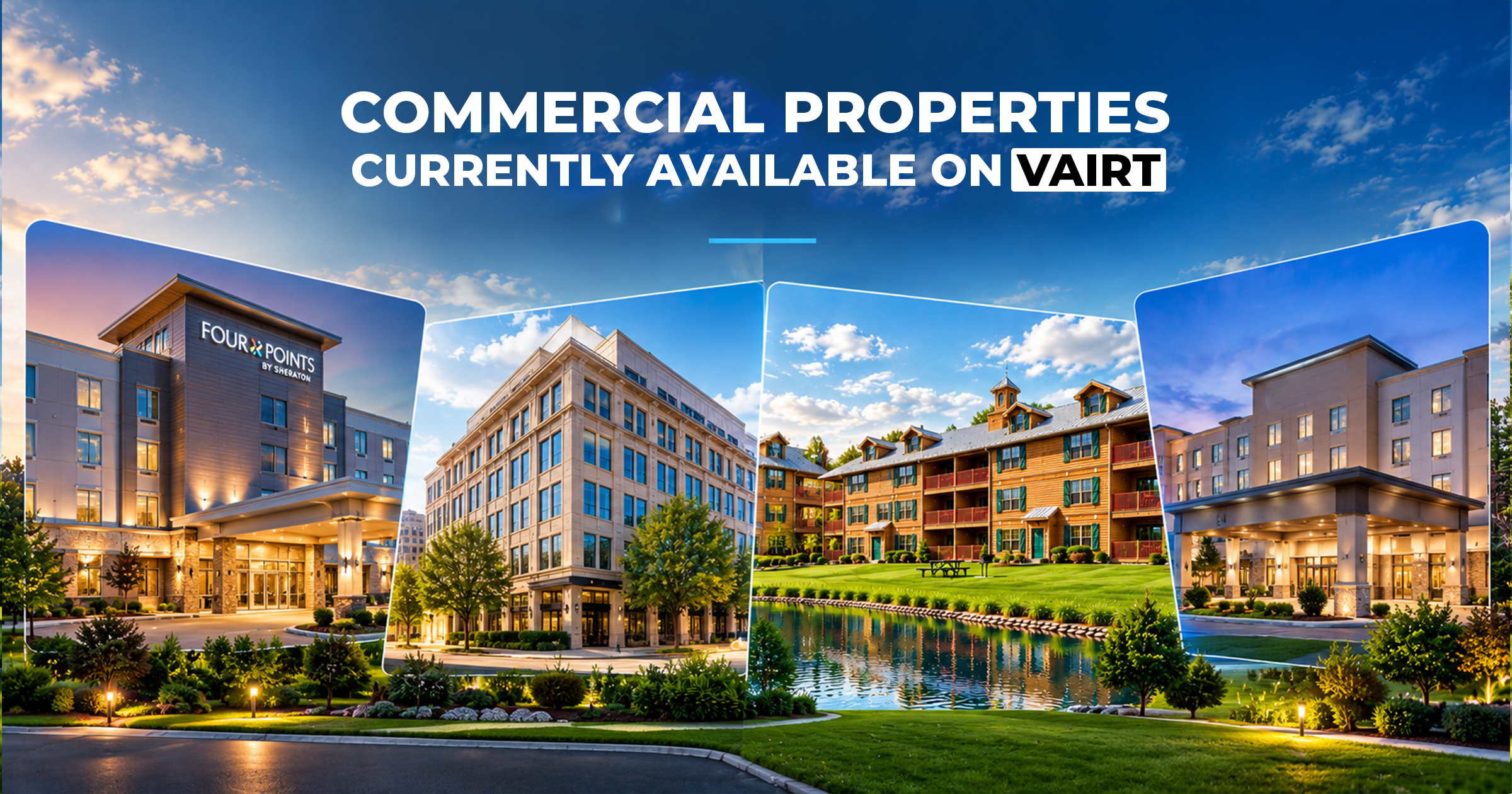
Vairt’s current U.S. listings give buyers access to several commercial property types. Selected current opportunities show a $25,000 minimum:
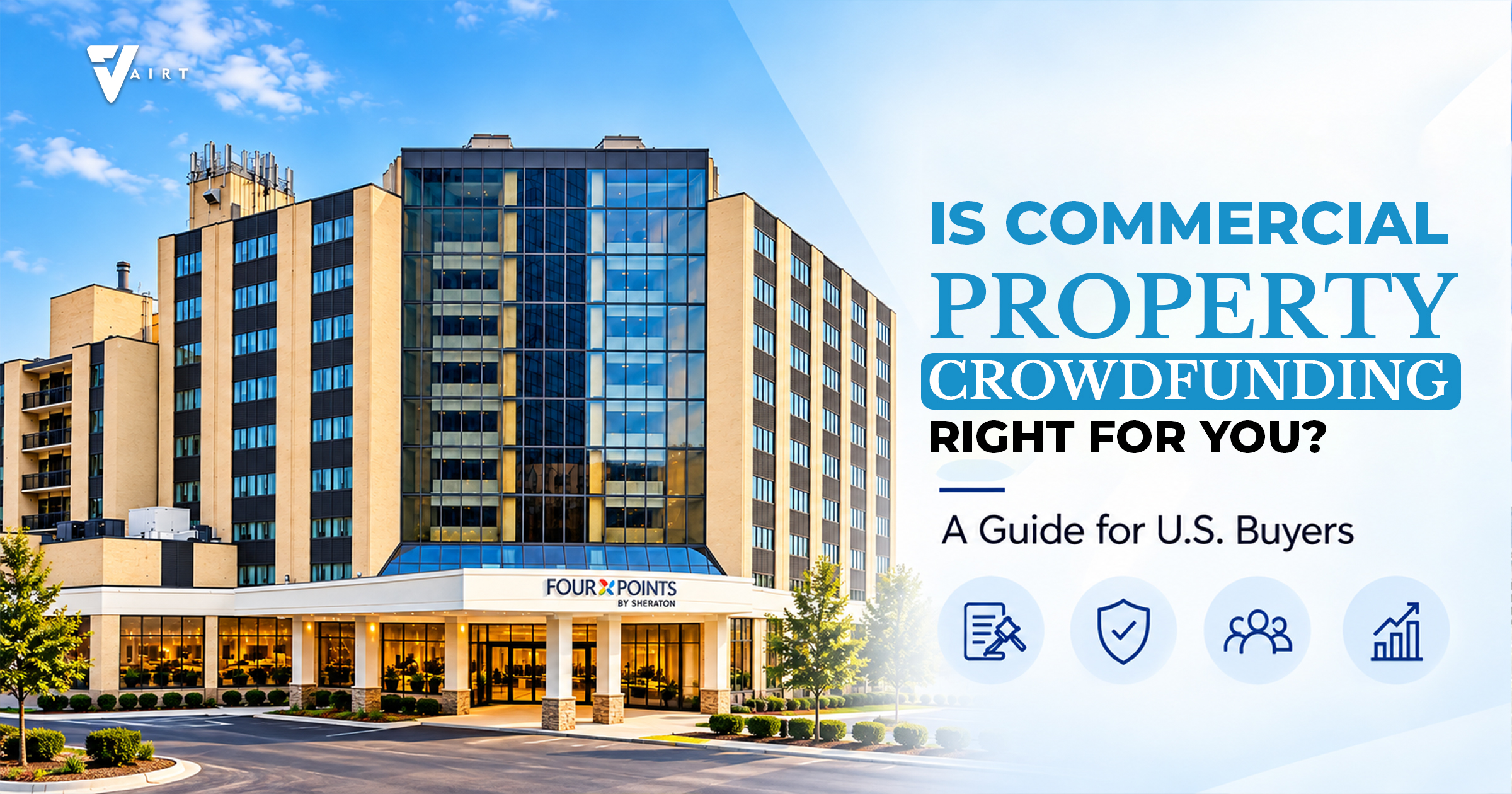
Four Points by Sheraton, downtown Peoria, Illinois: A 323-room, full-service hotel operating under a Marriott brand, described by Vairt as fully renovated and positioned for both income and long-term appreciation potential.
Commercial office and parking property, downtown Peoria, Illinois: A 272,876-square-foot property combining stabilized office space with a large structured parking facility, providing two separate income streams.
V Resort Living, Sheridan, Illinois: A proposed residential resort redevelopment with 332 residences across approximately 165 acres, with an acquisition and rehabilitation plan designed to reposition and stabilize the property.
Econo Lodge Inn & Suites, Triadelphia, West Virginia: A 113-room hotel with planned improvements aimed at increasing its income and value.
5 Million Star Hotel, Pennsylvania: A 60-unit hospitality development built around dome-style accommodations in a natural setting.
For each of these properties, the work covered in this guide, from inspections and leasing to daily operations and maintenance, is handled by professionals. Your role is to review the details, decide which property fits your goals, and follow its progress.
Full property details, including projections, cost breakdowns, holding terms, and eligibility, are available to registered users. Creating a Vairt account takes just a few minutes and lets you compare all of Vairt’s current commercial property opportunities side by side.
Thinking about buying commercial property but not sure where to start?
Schedule a free 15-minute call and we’ll walk you through how Vairt lets you own part of a professionally managed hotel, office, or residential property.
Fractional ownership takes the operational work off your plate, but you’re still the one deciding which property fits your goals. Reviewing a property’s location, income model, projected figures, holding period, and exit options helps you choose with confidence. Like all real estate, each property’s income follows its performance, including occupancy, operating costs, and market conditions, so understanding those details is part of making an informed choice.
Vairt recommends a five-year holding period, while selected opportunities also offer a 90-Day Exit Guarantee. Liquidity and exit terms can vary by property, so review the specific offering details before participating.
For a step-by-step framework, read our guide on how to evaluate an income-producing property opportunity before you commit. If you’re comparing ownership models, our guide on whether commercial property crowdfunding is right for you is a helpful next read, and our overview of commercial real estate passive income explains how these properties produce income.
Fractional commercial property ownership is a strong fit for people who want the benefits of owning commercial real estate without the capital and workload of buying a building outright. It works especially well for busy professionals who would rather review properties than manage tenants, contractors, or hotel staff, and for anyone who wants access to property types like full-service hotels and downtown office buildings.
It also suits people who are comfortable with a multi-year holding period and who like the idea of spreading their capital across several properties over time. Buyers who want complete control over every leasing and operating decision, or who plan to occupy the building for their own business, may prefer buying directly.
There are many things to consider when buying commercial property: your goals, the property type, location, condition, income, leases, financing, zoning, management, total costs, and your exit plan. For buyers taking on all of that directly, it’s a major commitment of capital, time, and expertise.
Professionally managed fractional ownership offers a simpler path. Vairt sources and screens properties, structures ownership through property-specific entities, and puts experienced teams in charge of operations, so you can focus on choosing the property that fits your goals.
When you’re ready to see real commercial properties, create a Vairt account to unlock full details for every current listing.
The most important things to consider when buying commercial property are your goals, the property type, location and local demand, physical condition, net operating income, tenant leases, financing, zoning, management, total ownership costs, and your exit plan. Together, these determine how much income the property can produce and how much work ownership will require.
Buying commercial property directly usually requires a significant down payment, plus closing costs, inspection and legal fees, and cash reserves. Commercial loans typically require larger down payments than home mortgages. Fractional ownership lowers the entry point considerably. Selected current U.S. opportunities on Vairt, including hotel, office, and residential properties, show a $25,000 minimum.
A cap rate is a property’s net operating income divided by its purchase price, and what counts as “good” depends on the property type, location, and condition. Properties in high-demand, stable locations often trade at lower cap rates, while properties in markets with more affordable prices may offer higher ones. Comparing cap rates across similar properties in the same market is the most useful approach.
Yes. Through professionally managed fractional ownership, you can own a share of a commercial property while an experienced team handles leasing, maintenance, and daily operations. On Vairt, ownership is generally structured through a property-specific LLC or SPV, income is transferred to owners’ digital wallets, and owners follow updates online without managing tenants or staff.
Yes, but the exact legal structure matters. With Vairt’s general fractional ownership model, participants hold ownership interests in a property-specific LLC or SPV that owns the underlying real estate. Your rights to distributable income, sale proceeds, voting, and transfers are governed by the terms of the specific offering.
Commercial property is generally held for several years so income and potential appreciation have time to build. Vairt recommends a five-year holding period, while selected opportunities may also include a 90-Day Exit Guarantee. Always review the specific property’s liquidity and exit terms before participating.

I'm Muhammad Waqas, a real estate content writer at Vairt with 8 years of experience writing about property ownership and real estate. I cover topics such as fractional real estate, hotel and commercial property ownership, and how to evaluate income-producing properties. My writing focuses on helping U.S. readers understand how professionally managed real estate works, including its benefits, risks, and structure, before they explore an opportunity.

Certain statements contained in this document constitute forward-looking statements. Such forward-looking statements, including our intended actions and performance objectives, projections, targets, estimates, or forecasts involve known and unknown risks, uncertainties and other important factors, including our ability to successfully develop and operate the Vairt Marketplace, our business model and the services we intend to offer. These factors are based on expectations and assumptions that may change and are subject to regulatory uncertainty, changes in our legal environment and the blockchain and real estate industries generally, which could cause our actual results, performance or achievements to differ materially from any future results, performance or achievements expressed or implied by such forward-looking statements. All amounts, numbers, ranges, and values presented in this document are subject to material change and should be taken as preliminary and indicative only. Any such amounts, numbers, ranges, and values are based upon preliminary estimates, remain subject to ongoing analysis and may change materially. All forward-looking statements in this document speak only as of the date hereof. We expressly disclaim any obligation to update any forward-looking statement to reflect any change in our expectation or any change in events, conditions, assumptions or circumstances.
_(1)_.jpg)

Comments