



Finding a real estate company you can trust involves more than checking online ratings or browsing attractive properties. With different ownership models, management arrangements, and financial structures available, choosing the right company requires understanding who manages your property, how ownership is documented, and where potential income comes from.
If you're asking, "How do I find a reputable real estate investment company?" the answer starts with transparency, operational experience, property-level due diligence, and clearly documented ownership terms. A reputable company should make it easy to understand what you're purchasing, how the property will be managed, and what you can reasonably expect throughout the ownership period.
For U.S. buyers interested in professionally managed real estate, platforms such as Vairt provide an alternative to purchasing entire properties independently. Understanding how these platforms operate can help you evaluate available opportunities with greater confidence.
Looking for a Real Estate Company You Can Trust? Schedule a 15-minute meeting with Vairt to understand its property review process, ownership structure, and available real estate opportunities.
A reputable real estate company should have an identifiable business structure, a transparent property selection process, experienced management, and clearly explained financial arrangements. The company should provide enough information for buyers to understand the properties they are considering before making a financial commitment.
Start by researching the company's business history, legal identity, and experience with the property types it offers. A company specializing in commercial hospitality properties, for example, should understand hotel occupancy, operating expenses, property maintenance, and the management requirements associated with that sector.
You should also understand how the company communicates with owners after a property is acquired. Some companies primarily assist with property transactions, while others provide ongoing ownership administration and professional management. Learning about the company's ownership and property management process can help you determine which responsibilities remain with the owner and which are handled by the management team.
Where applicable, buyers can verify financial professionals through the U.S. Securities and Exchange Commission's professional background-check resources. State business registration records may also help establish a company's legal identity, although registration alone does not establish the quality of its properties or services.
The goal is to identify a company whose operations, documentation, and communication support informed long-term property ownership.

Trustworthy real estate companies build confidence through consistent processes rather than promotional promises. Buyers should be able to understand how properties are selected, which professionals oversee them, what expenses are involved, and how ownership interests are administered.
Property screening is particularly important because not every available building is suitable for the same ownership strategy. A professionally managed company should consider location, current property condition, income potential, local demand, and the operating assumptions behind each opportunity.
Vairt uses a proprietary 100-point screening tool, supported by third-party valuation, to evaluate potential property opportunities. Its property review process also describes how sponsors, underlying assets, and supporting documentation are assessed before opportunities are presented to participants.
A company's history and leadership are equally relevant. Reviewing the people behind the business, their professional experience, and their approach to property management provides useful context. Buyers researching Vairt can explore the company's background and business approach to better understand how its property ownership platform is positioned.
Clear communication should continue after the initial purchase. Owners benefit from having access to performance information, property updates, and explanations of material developments throughout the holding period.

Understanding the ownership structure helps buyers identify exactly what legal interest they receive, how that interest relates to a physical property, and which rights are attached to their participation.
Direct ownership typically means purchasing property in your own name or through a personally controlled legal entity. Fractional ownership works differently because multiple participants hold proportional interests in a property through an established ownership arrangement.
For example, Vairt structures each funded property through a property-specific limited liability company, or LLC. An LLC is a legal business entity that can hold real estate and define the rights and responsibilities of its owners. Anyone unfamiliar with this approach can review how partial property ownership works through real estate platforms before comparing individual opportunities.
Under Vairt's stated model, each property-specific LLC is divided into one million shares, with participants receiving an allocation proportional to their contribution. This allows ownership interests to be associated with a particular property rather than requiring one individual to acquire the entire asset.
Buyers should review the applicable legal documents to understand voting rights, income distribution arrangements, transfer provisions, and ownership responsibilities. These details explain how participation operates beyond the initial transaction.
Understand Property Ownership Before Choosing Your Opportunity Schedule a 15-minute meeting with Vairt to discuss fractional ownership, property-specific LLCs, and available real estate opportunities.
Financial transparency means being able to understand how a property generates revenue, which expenses are deducted, and what assumptions support any projected income figures.
A reputable company should provide a reasonable explanation of the property's operating model, including occupancy expectations, management costs, maintenance requirements, and anticipated holding period. For income-producing properties, reviewing the relationship between revenue and operating expenses is especially useful.
Net operating income, or NOI, generally refers to property revenue remaining after normal operating expenses, before financing costs and certain other deductions. A capitalization rate, or cap rate, compares a property's annual NOI with its value or purchase price and is commonly used to assess commercial property pricing.
Buyers can develop a stronger understanding of these calculations by learning how to evaluate an income-producing property opportunity and examining the assumptions behind projected distributions. An attractive percentage should always be considered alongside the actual property, operating expenses, and ownership agreement.
Management fees, administrative expenses, maintenance reserves, and potential transaction costs should also be reviewed. Understanding these components helps buyers distinguish total property revenue from the amount potentially available for distribution to owners.
The answer depends on how much control, capital, and operational involvement a buyer wants.
Direct property ownership gives buyers substantial control over acquisition decisions, financing, renovations, tenant selection, and eventual sale. However, it also places more responsibility on the owner, even when a property management company is hired.
Professionally managed fractional ownership takes a different approach. Participants select from available properties and hold a defined ownership interest, while operating teams handle responsibilities such as property maintenance, occupancy management, and daily administration.
For buyers who want exposure to commercial property without personally operating hotels, office buildings, or residential communities, reviewing currently available real estate ownership opportunities can provide a practical starting point. Comparing property types, projected income, and holding periods can help buyers identify arrangements that align with their goals.
This approach does not eliminate changes in property performance. Rather, it allows owners to focus on selection and monitoring instead of routine operations.
Vairt provides a digital platform through which eligible participants can explore U.S. real estate opportunities, review property information, and participate in fractional ownership arrangements.
The process begins with property discovery and evaluation. Prospective owners review available assets, consider their financial objectives, and examine the ownership terms before choosing an opportunity.
According to Vairt's stated process, properties are offered through a 30-day funding window, with committed funds held in escrow. If a property does not reach its required funding level, the committed amount is returned to the participant's digital wallet without a charge.
Once a property is fully funded, ownership interests are allocated through its property-specific LLC. Professional teams manage property operations, while participants can monitor relevant information using Vairt's digital dashboard and mobile application.
For buyers considering this model, creating a Vairt account takes a few minutes and provides access to additional property information and the onboarding process. Reviewing the available documents helps participants understand the specific eligibility conditions and ownership arrangements before proceeding.
Vairt's currently listed opportunities generally begin at $25,000, although individual property eligibility requirements may differ.
The properties offered by a real estate company can reveal a great deal about its operating approach. Hotels, commercial office buildings, parking facilities, and residential developments have different income sources, maintenance requirements, and management considerations.
Vairt's U.S. portfolio includes several property types that buyers can compare to understand these differences.
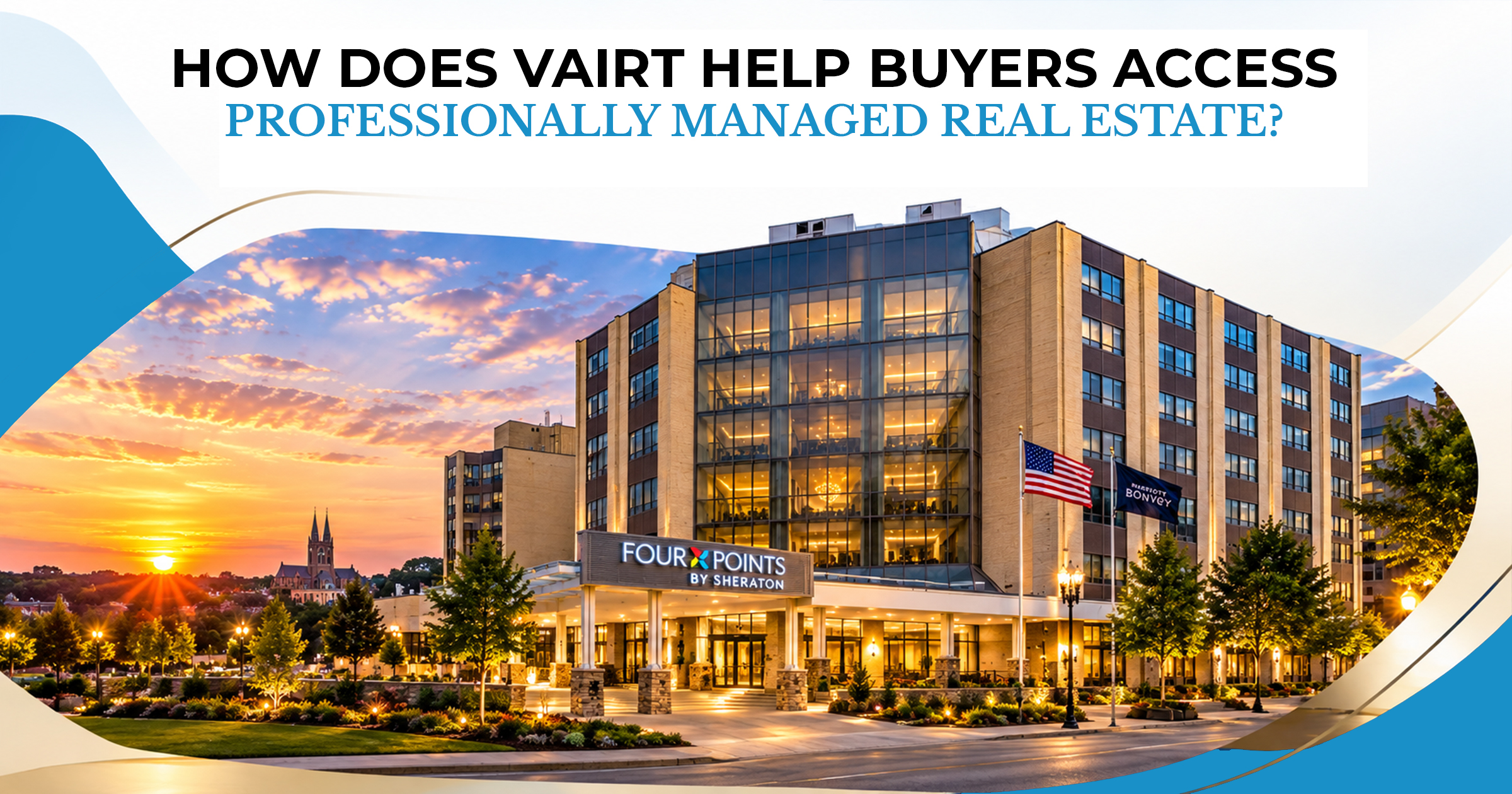
Located at 500 Hamilton Boulevard in downtown Peoria, Illinois, Four Points by Sheraton is a 323-room, full-service hotel operating under the Marriott brand. The property completed a $40 million renovation in 2020 and serves a location associated with corporate activity, business travel, and events.
Vairt presents the property as a professionally managed hospitality ownership opportunity with projected annual rental income of 7%–9% during years one through five, with monthly distributions contemplated. Buyers reviewing the Four Points by Sheraton ownership opportunity can examine the property's hospitality operating model, ownership terms, and supporting documents to understand how the offering is structured.
The hotel illustrates how participants may gain exposure to commercial hospitality real estate without personally managing guest services, staffing, or daily property operations.
Another Vairt listing combines office space with a structured parking facility at 222 Northeast Monroe Street in downtown Peoria, Illinois.
The property totals approximately 272,876 square feet, including around 68,360 square feet of office space and a seven-story parking structure with roughly 552 parking spaces.
Unlike a hotel, this property combines office leasing with parking operations, creating two distinct sources of potential operating revenue. Vairt projects annual rental income of 8%–10% during years one through five, with planned monthly distributions.
Prospective participants can examine the commercial office and parking ownership opportunity to learn more about how its income sources, management structure, and five-year holding period are presented.
Both examples demonstrate why property-specific evaluation matters. Income projections are not guaranteed, and actual distributions depend on occupancy, operating expenses, reserves, and market conditions.
Not sure how to compare property screening, ownership structures, and income projections?
Schedule a free 15-minute call with the Vairt team to discuss available U.S. properties, participation requirements, and how professionally managed ownership works.
Before choosing a company, buyers should understand how opportunities are sourced, what documentation is available, and how financial and ownership arrangements operate.
Ask who is responsible for managing the underlying property, how operating income is calculated, and whether distributions depend on occupancy or other performance factors. It is also useful to ask about management fees, reserve policies, ownership rights, reporting frequency, and any applicable eligibility standards.
The holding period deserves particular attention. Vairt's stated model uses a five-year holding period and describes a 90-day exit option, alongside potential secondary-market transfers or an owner vote to sell a property. These are mechanisms to review under the relevant offering documents, not guarantees of immediate liquidity.
Anyone comparing direct purchases with professionally managed arrangements may also benefit from understanding what to consider when buying commercial property, including financing, property condition, management responsibilities, and long-term ownership costs.
The strongest questions are those that help clarify what buyers will actually own and how that ownership will operate over time.
If you're still wondering, "How do I find a reputable real estate investment company?" focus on the evidence behind the business rather than its promotional claims.
Review the company's legal structure, property screening procedures, management capabilities, financial disclosures, and ownership arrangements. A credible property ownership provider should help you understand both the available opportunities and your responsibilities as a participant.
Vairt offers a professionally managed alternative for individuals interested in fractional ownership of U.S. hotels, commercial properties, and residential real estate. Through its property screening process, ownership framework, and digital platform, participants can explore opportunities without assuming responsibility for daily operations.
You can create your Vairt account to explore additional property information, review the applicable ownership documents, and determine which available opportunities align with your financial objectives and preferred holding period.
Ready to Review Real Estate Opportunities? Schedule a 15-minute meeting with Vairt to discuss its property review process, ownership structure, and available U.S. real estate opportunities.
Check the company's registration, experience, property selection process, and management expertise. Review ownership documents, financial terms, and transparency before making a decision.
Look for clear ownership terms, professional property management, transparent fees, reliable financial reporting, and defined holding periods and exit options.
Yes. Fractional ownership allows you to own a share of commercial real estate while professional teams manage operations, maintenance, and leasing.
Vairt's featured U.S. properties generally start at $25,000. Minimum amounts and eligibility requirements vary by property.
Properties generate revenue through hotel bookings, rental payments, or other operations. Owners may receive distributions after expenses, fees, and reserves, depending on performance.

I'm Muhammad Waqas, a real estate content writer at Vairt with 8 years of experience writing about property ownership and real estate. I cover topics such as fractional real estate, hotel and commercial property ownership, and how to evaluate income-producing properties. My writing focuses on helping U.S. readers understand how professionally managed real estate works, including its benefits, risks, and structure, before they explore an opportunity.

Certain statements contained in this document constitute forward-looking statements. Such forward-looking statements, including our intended actions and performance objectives, projections, targets, estimates, or forecasts involve known and unknown risks, uncertainties and other important factors, including our ability to successfully develop and operate the Vairt Marketplace, our business model and the services we intend to offer. These factors are based on expectations and assumptions that may change and are subject to regulatory uncertainty, changes in our legal environment and the blockchain and real estate industries generally, which could cause our actual results, performance or achievements to differ materially from any future results, performance or achievements expressed or implied by such forward-looking statements. All amounts, numbers, ranges, and values presented in this document are subject to material change and should be taken as preliminary and indicative only. Any such amounts, numbers, ranges, and values are based upon preliminary estimates, remain subject to ongoing analysis and may change materially. All forward-looking statements in this document speak only as of the date hereof. We expressly disclaim any obligation to update any forward-looking statement to reflect any change in our expectation or any change in events, conditions, assumptions or circumstances.




Comments