


Building wealth through real estate has traditionally meant buying an entire property, arranging financing, finding tenants, and managing ongoing expenses. For many Americans, the biggest challenge isn't understanding the value of property ownership. It's finding a practical way to get started without committing substantial capital or taking on landlord responsibilities.
If you're researching how to build wealth through real estate, fractional ownership offers an alternative worth exploring. Instead of purchasing a complete building, you can own a proportional interest in an income-producing property alongside other participants.
This approach creates opportunities to participate in commercial real estate, receive potential rental income, and benefit from long-term property value changes while professional teams handle daily operations.
Through platforms such as Vairt, eligible participants can explore professionally managed U.S. properties, review their financial details, and select ownership opportunities that align with their goals.
The key is understanding how real estate creates wealth, how fractional ownership works, and what makes one property opportunity different from another.
Ready to Build Wealth Through Real Estate Opportunities? Schedule a 15-minute meeting with Vairt to discuss fractional ownership and professionally managed U.S. real estate opportunities.

Real estate can contribute to long-term wealth through two primary mechanisms: income generated by a property and potential appreciation in its market value.
Income-producing properties collect revenue from activities such as residential rentals, commercial leases, hotel accommodations, and parking operations. After operating expenses and applicable obligations are covered, some of the remaining cash may become available for distribution to owners.
Property appreciation provides another potential source of wealth creation. Appreciation means an increase in the market value of a property over time. It can be influenced by location, local demand, property improvements, rental performance, and broader real estate conditions.
Consider a commercial building that generates rental income while maintaining strong occupancy and improving its operating performance. Owners may benefit from available cash distributions during the holding period and potentially from the property's value when it is sold.
However, income and appreciation are not automatic. Actual results depend on the property's performance, expenses, market conditions, and sale arrangements.
For individuals seeking recurring property income without managing an entire building, Vairt's guide to commercial real estate passive income explains how professionally managed properties can support income objectives while allowing owners to remain outside daily operations.
Understanding these two potential sources of wealth is the foundation for evaluating any property ownership strategy.

Fractional real estate ownership is a structure in which multiple participants own proportional economic interests in the same property rather than requiring one person to acquire the entire asset.
Each participant contributes capital according to the terms of the opportunity and receives an ownership interest through the applicable legal structure.
For example, a commercial hotel may be held by a property-specific limited liability company (LLC). An LLC is a legal entity that can own property and establish the rights and responsibilities of its members.
Participants hold shares or membership interests in the company that owns the property rather than personally owning individual hotel rooms or designated sections of the building.
The arrangement allows ownership responsibilities and potential financial outcomes to be shared according to the governing documents.
Fractional ownership is particularly relevant for larger commercial properties, where the capital required for direct acquisition may be beyond what an individual wants to allocate to one asset.
It can also reduce the need for direct operational involvement because property management is typically handled by designated professionals.
Vairt's explanation of partial property ownership through real estate platforms provides additional detail about how ownership interests, income distributions, and shared property structures work together.
The appeal is straightforward: participants can evaluate specific real estate assets without purchasing and operating those properties independently.
A successful real estate wealth-building approach begins with selecting suitable properties, understanding their financial performance, and planning for a realistic ownership period.
Fractional ownership changes how an individual accesses a property, but the fundamental drivers of financial performance remain the same.
The first step is identifying a property with a clearly understandable source of revenue.
Residential rental properties generate income through tenant payments. Commercial buildings earn revenue through business leases, while hospitality properties generate revenue through guest accommodations and related services.
Properties with multiple revenue sources may also offer opportunities to diversify operating income within a single asset.
For example, a commercial office building with an attached parking facility may collect payments from office tenants alongside revenue from parking operations.
The important question is how much of that revenue remains available after operating expenses, property obligations, and required reserves.
Rather than selecting a property exclusively because of an attractive projected income percentage, review its actual revenue model and the assumptions used to estimate future performance.
A property's ability to generate wealth depends partly on how effectively it converts revenue into available cash.
Operating expenses vary across property types. Hotels require staffing, housekeeping, maintenance, and guest services, while commercial buildings incur expenses associated with maintenance, taxes, insurance, utilities, and tenant support.
Net operating income (NOI) measures property revenue remaining after ordinary operating expenses, before financing costs and certain other financial obligations.
A property with strong gross revenue can still have limited distributable cash if its operating expenses and other obligations are substantial.
Understanding the difference between income and cash available for distribution is essential when comparing ownership opportunities.
Vairt's guide to evaluating income-producing property opportunities explains how occupancy, property expenses, management arrangements, and financial projections contribute to an informed property review.
The objective is to identify properties with a sound operating model rather than focusing only on headline income projections.
Property ownership often requires a considerable amount of ongoing work.
Owners who manage residential properties directly may need to screen tenants, collect rent, coordinate repairs, manage vacancies, and oversee maintenance.
Commercial property responsibilities can be more demanding, particularly when dealing with office tenants, hospitality operations, or large facilities.
Professional management provides an alternative by assigning these responsibilities to an experienced operating team.
Under a professionally managed fractional ownership arrangement, participating owners generally do not handle daily tenant communication, hotel reservations, or routine maintenance.
Instead, they monitor financial results and property updates while the management team coordinates operations.
This structure can be useful for people who want real estate exposure while maintaining focus on their careers, businesses, or other responsibilities.
Real estate wealth-building generally benefits from a defined ownership strategy.
Some participants prioritize recurring income, while others focus on potential property appreciation or a combination of both.
An operating property may offer a different financial profile from a building undergoing improvements or a hospitality project still in development.
For example, an established commercial property can provide operating information that helps participants understand its revenue and expenses.
A value-add property, by comparison, may focus on renovations or operational improvements intended to strengthen future performance. A development property requires construction and operational milestones before it can establish normal rental or hospitality revenue.
Each approach has a different timeline and set of financial assumptions.
An effective long-term strategy involves reviewing these differences, selecting suitable assets, and understanding how long ownership interests are expected to be held.
Vairt provides a U.S.-focused platform that connects eligible participants with selected professionally managed fractional real estate opportunities.
Its model is designed to simplify the process of discovering properties, reviewing ownership details, participating in funding, and monitoring property performance.
Rather than requiring each participant to independently source a commercial building, coordinate acquisition, and arrange ongoing property management, Vairt brings these activities together through a structured platform.
Vairt identifies potential property opportunities and evaluates their suitability before presenting them for participant review.
The platform describes a proprietary 100-point screening framework supported by a third-party valuation process. Its published property screening and review process also addresses sponsor history, property assumptions, market data, and supporting documentation.
This gives prospective owners a starting point for comparing opportunities based on the characteristics of the underlying property.
Individual participants can then evaluate whether the property type, location, expected income, and holding period match their objectives.
According to Vairt's approved operating model, property opportunities are listed for a 30-day funding period.
Participant funds are held in escrow while the funding process is underway. If the required funding target is not achieved, the committed amount is returned to the participant's digital wallet at no cost.
Successfully funded properties use a property-specific LLC structure, with one million shares allocated proportionally according to participant contributions.
This allows multiple eligible participants to hold economic interests in the same underlying property.
Readers can explore Vairt's step-by-step real estate ownership process to understand how property selection, funding, ownership allocation, professional management, and long-term participation fit together.
After the acquisition and applicable ownership arrangements are completed, designated professional teams manage the property's day-to-day operations.
These responsibilities may include occupancy management, maintenance coordination, tenant services, hospitality operations, and other activities appropriate to the asset.
Under Vairt's approved model, available rental income is intended to be distributed monthly into each owner's digital wallet, where it may be withdrawn or directed toward another eligible opportunity.
Owners can also review performance through Vairt's dashboard and mobile application.
Monthly distribution frequency does not establish a fixed payment amount. Actual income depends on the property's revenue, expenses, reserves, and applicable distribution terms.
For readers ready to move beyond general research, creating a Vairt account takes a few minutes and unlocks access to fuller property details, supporting documents, and eligibility information.
Real estate wealth-building opportunities vary according to property type, location, operating performance, and long-term objectives.
Vairt features U.S. commercial and hospitality properties that illustrate different ways professionally managed real estate can generate potential income and long-term value.
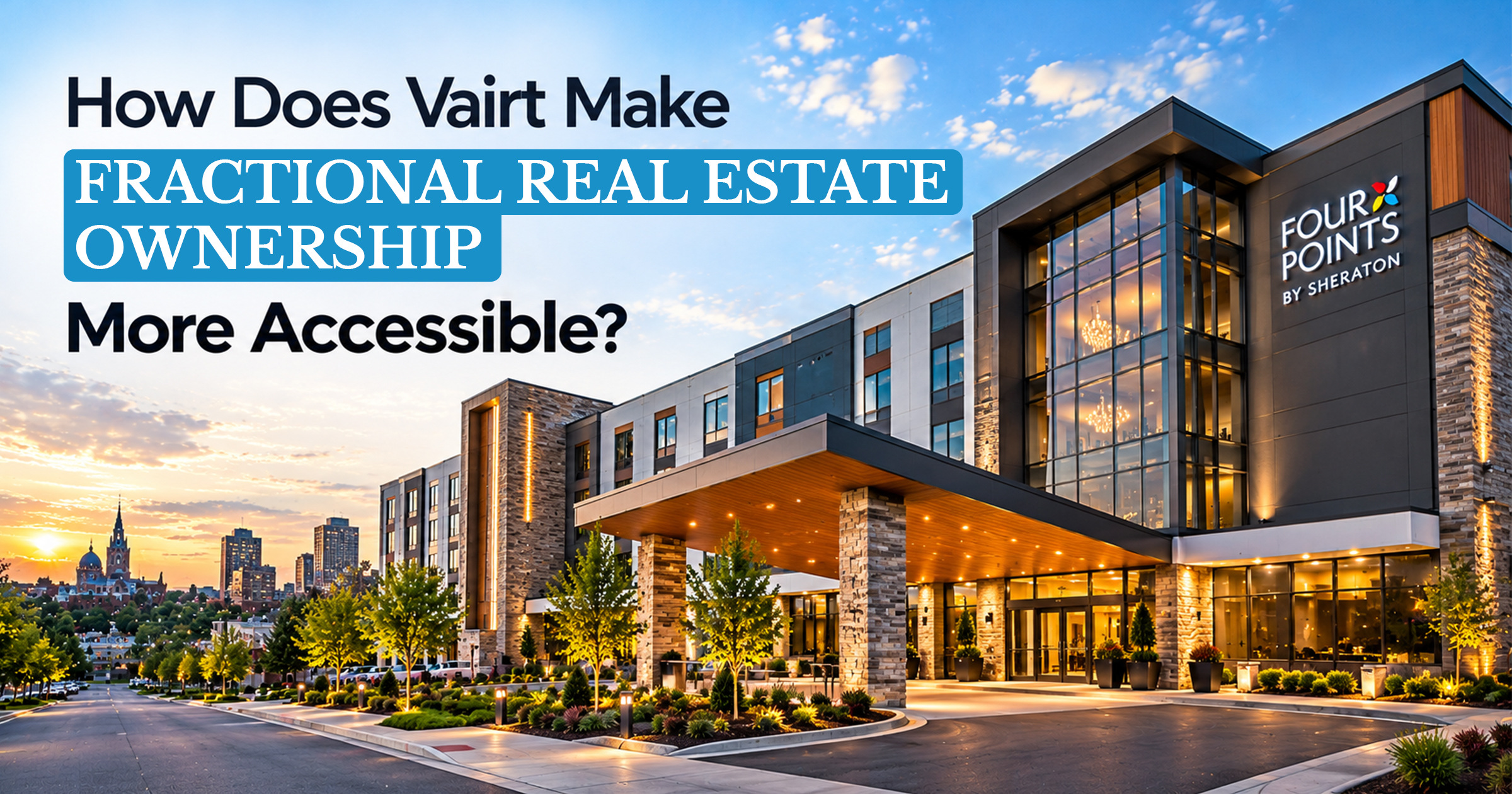
Four Points by Sheraton, located at 500 Hamilton Boulevard in downtown Peoria, Illinois, is a 323-room full-service hotel operating under a Marriott brand.
The property underwent a $40 million renovation completed in 2020 and serves a location influenced by corporate travel, business activities, and regional events.
Hospitality revenue is primarily influenced by guest occupancy, room rates, demand, and operating expenses.
The listing presents projected annual rental income of 7%–9% during years one through five, with monthly distributions when cash is available. These are projected figures, not assured income.
Through the Four Points by Sheraton ownership opportunity, eligible participants can explore the property's income model, ownership arrangements, and supporting documents without taking responsibility for hotel operations themselves.
The property illustrates how fractional ownership can provide access to a professionally operated hospitality asset while allowing participants to focus on potential income and long-term property value.
Vairt also features a commercial office and parking property at 222 NE Monroe Street in downtown Peoria.
The property comprises approximately 272,876 square feet, including around 68,360 square feet of office space and a seven-story parking deck with roughly 552 parking spaces.
Its income model differs from hospitality because it combines commercial office leasing with parking operations.
The listing presents projected annual rental income of 8%–10% during years one through five, with monthly distributions when available. Actual financial performance depends on property occupancy, parking demand, operating expenses, and market conditions.
Prospective owners can examine the Commercial Office & Parking ownership opportunity to understand how its property characteristics and multiple revenue sources contribute to the overall ownership model.
Both properties demonstrate how fractional ownership can connect participants with real commercial assets that would typically require substantial capital and operational resources to own independently.
Interested in building long-term wealth through commercial real estate but unsure which property fits your goals?
Schedule a free 15-minute call to discuss fractional ownership, available U.S. properties, potential income, and eligibility requirements with the Vairt team.
A thoughtful ownership decision starts with understanding exactly what you are acquiring.
For fractional ownership, this means examining the underlying property, the LLC structure, participation rights, management arrangements, and financial documentation.
The income model deserves particular attention. Review how the property generates revenue, what expenses it must cover, and how projected distributions are calculated.
Consider occupancy levels, local demand, property condition, operating costs, and any planned improvements.
An established property may provide operating records for review, while value-add and development properties depend on renovation or construction timelines and future operating milestones.
Participants should also understand the expected holding period. Vairt uses a five-year holding period and describes a 90-day exit option, potential secondary-market share sales, and owner-vote arrangements relating to a property sale.
These exit arrangements depend on applicable terms and market conditions. Liquidity—the ability to convert an ownership interest into cash, should be evaluated independently of the property's monthly distribution schedule.
Income is not guaranteed, and property values can change. Reviewing the legal documents, financial assumptions, fees, and eligibility requirements helps prospective owners make informed decisions.
Vairt's background, available through the Vairt story, provides additional context about the platform and its approach to property ownership.
Understanding how to build wealth through real estate begins with recognizing the potential value of income-producing properties and long-term ownership.
Traditional property acquisition can require substantial capital, ongoing management, and direct responsibility for maintaining the asset.
Fractional ownership offers an alternative by allowing eligible participants to hold proportional interests in professionally managed properties.
Through Vairt, participants can explore selected U.S. commercial and hospitality assets, review available financial documents, monitor property performance, and consider opportunities for potential rental income and long-term appreciation.
The most suitable approach depends on available capital, financial goals, property performance, eligibility, and expected holding periods.
Before participating, review the property's ownership structure, projected income, management arrangements, and applicable exit terms.
To explore available opportunities, create your Vairt account and access full property details so you can compare professionally managed U.S. real estate opportunities aligned with your long-term goals.
Ready to Build Wealth Through Real Estate Opportunities? Schedule a 15-minute meeting with Vairt to discuss fractional ownership and professionally managed U.S. real estate opportunities.
Fractional ownership allows you to own a proportional interest in income-producing real estate. Potential wealth growth comes from rental income and property appreciation, depending on market conditions and performance.
Yes. Professionally managed properties may generate rental income, with available profits distributed according to ownership shares after expenses. Returns are not guaranteed.
Minimum amounts vary by property. Vairt currently lists opportunities starting at $25,000, subject to eligibility requirements and ownership terms.
Not exactly. With Vairt, participants own proportional interests in a property-specific LLC rather than holding direct title to an individual physical space.
Long-term value may come from rental income, property improvements, and appreciation. Actual returns depend on property performance and market conditions.

I'm Muhammad Waqas, a real estate content writer at Vairt with 8 years of experience writing about property ownership and real estate. I cover topics such as fractional real estate, hotel and commercial property ownership, and how to evaluate income-producing properties. My writing focuses on helping U.S. readers understand how professionally managed real estate works, including its benefits, risks, and structure, before they explore an opportunity.

Certain statements contained in this document constitute forward-looking statements. Such forward-looking statements, including our intended actions and performance objectives, projections, targets, estimates, or forecasts involve known and unknown risks, uncertainties and other important factors, including our ability to successfully develop and operate the Vairt Marketplace, our business model and the services we intend to offer. These factors are based on expectations and assumptions that may change and are subject to regulatory uncertainty, changes in our legal environment and the blockchain and real estate industries generally, which could cause our actual results, performance or achievements to differ materially from any future results, performance or achievements expressed or implied by such forward-looking statements. All amounts, numbers, ranges, and values presented in this document are subject to material change and should be taken as preliminary and indicative only. Any such amounts, numbers, ranges, and values are based upon preliminary estimates, remain subject to ongoing analysis and may change materially. All forward-looking statements in this document speak only as of the date hereof. We expressly disclaim any obligation to update any forward-looking statement to reflect any change in our expectation or any change in events, conditions, assumptions or circumstances.



Comments