






Hotel ownership is often associated with wealthy investors, large real estate companies, and multimillion-dollar acquisitions. Buying an entire hotel can require substantial capital, but that doesn't mean every investor needs millions of dollars to participate in hotel real estate.
Today, different investment structures allow individuals to gain exposure to hospitality properties without purchasing an entire building. One option is fractional hotel ownership, where multiple investors participate in an ownership structure connected to a specific property.
Through Vairt, eligible investors can explore selected U.S. hotel ownership opportunities starting at $25,000, subject to availability, eligibility requirements, and offering terms. Professional management teams handle daily hotel operations, while investors can participate in potential property income and long-term appreciation.
However, a lower starting investment doesn't eliminate financial risk. Understanding the ownership structure, hotel performance, expenses, and exit conditions is essential before making a decision.
Ready to Explore Hotel Ownership Opportunities Starting at $25,000? Schedule a 15-minute meeting with Vairt to discuss fractional hotel ownership and professionally managed U.S. hospitality properties.
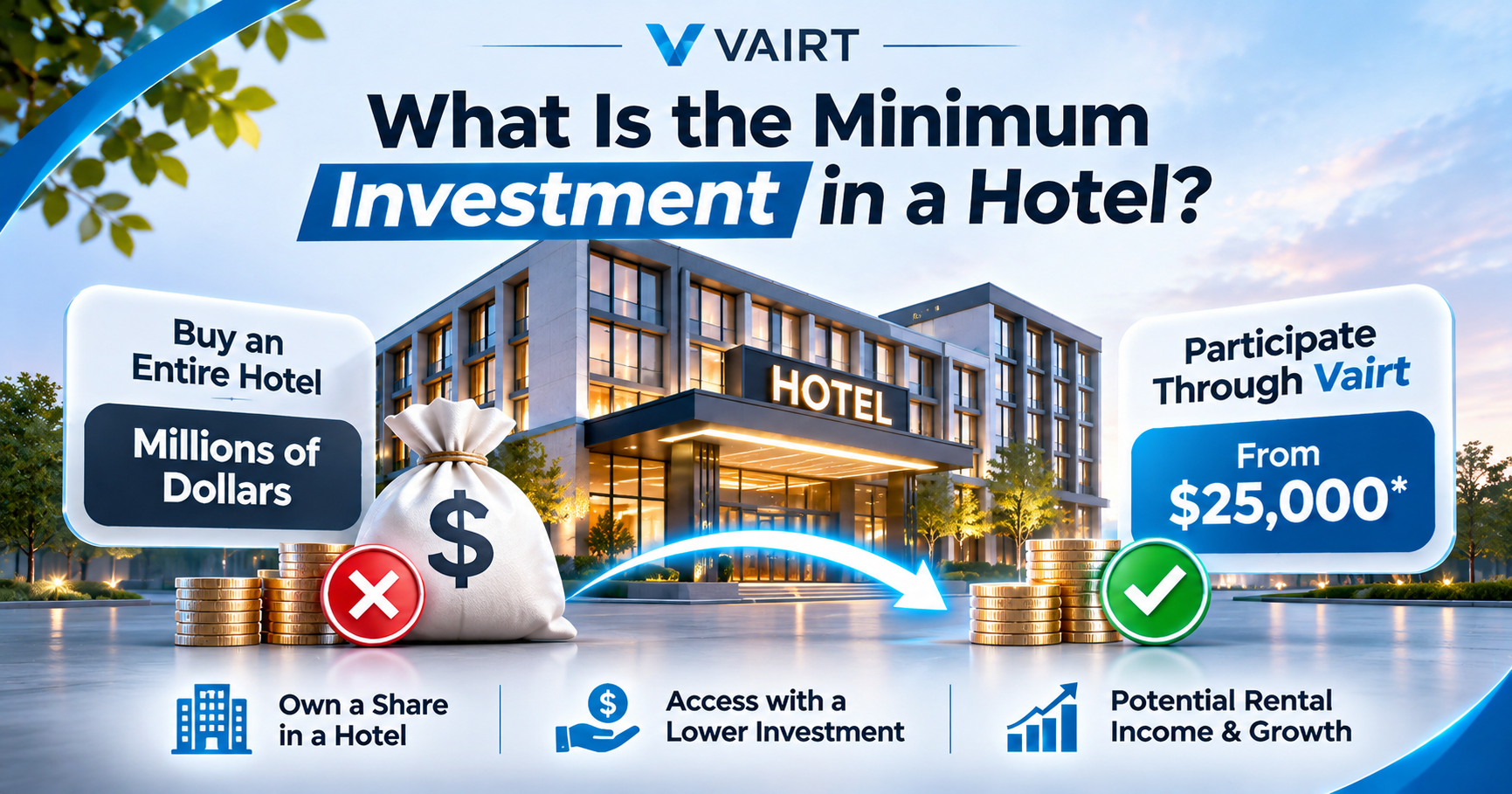
There is no universal minimum investment amount for hotel real estate. The amount required depends on the property, investment structure, financing arrangements, and eligibility requirements.
Purchasing an entire hotel generally requires substantial capital. Investors must consider the acquisition price, closing costs, property improvements, operating expenses, insurance, and financial reserves.
However, buying an entire property is not the only option.
Investors may gain exposure to hospitality real estate through hotel-focused real estate investment trusts (REITs), private partnerships, or fractional ownership arrangements.
Each structure has different minimum investment requirements and ownership rights.
For example, Vairt offers selected fractional hotel ownership opportunities starting at $25,000. Instead of purchasing a complete hotel, eligible participants can acquire a proportional interest through a property-specific ownership entity.
This provides a different entry point into hotel real estate, although investment amounts, fees, and eligibility requirements vary by offering.
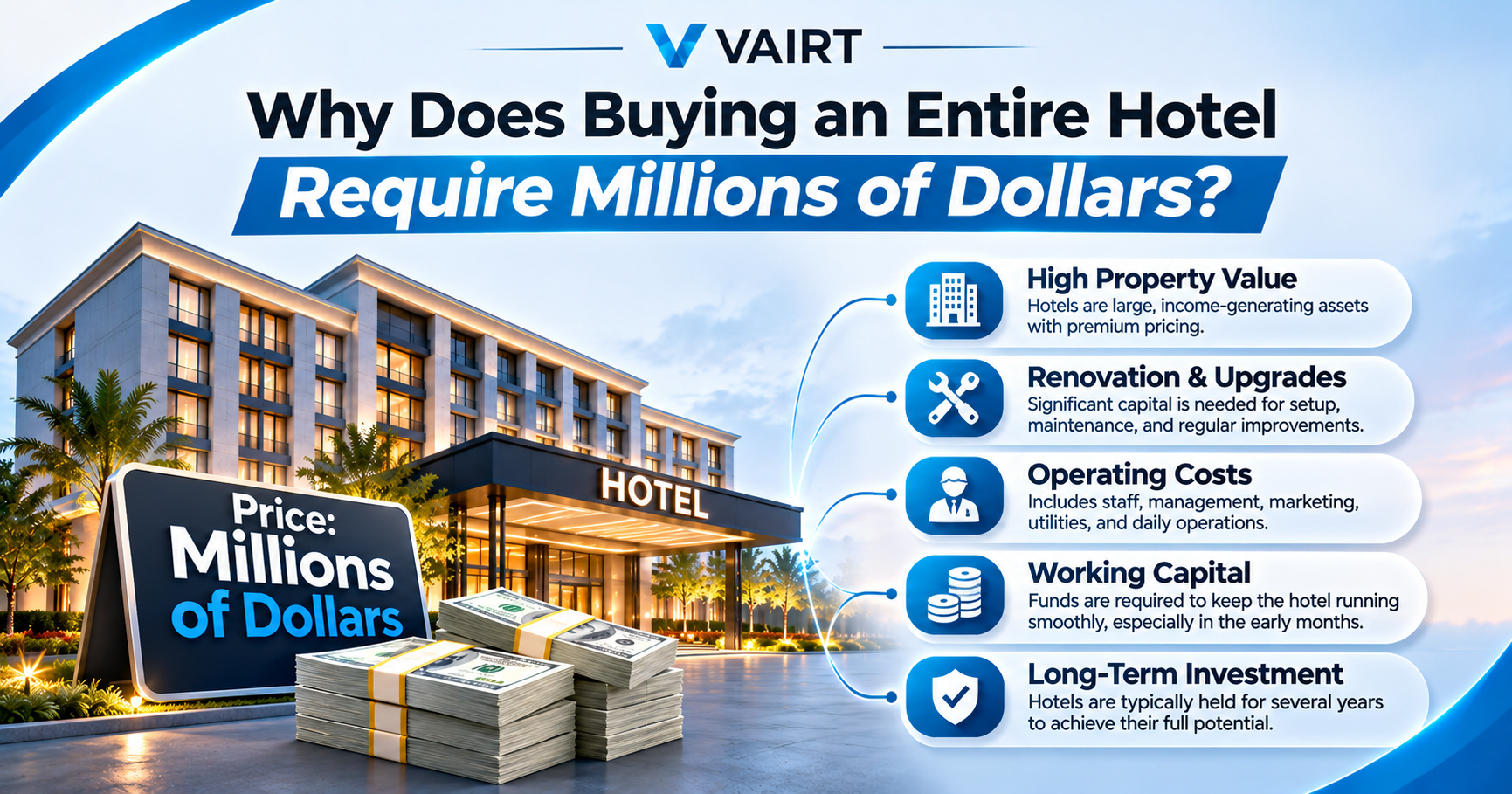
A hotel is both a real estate asset and an operating business. Unlike certain residential rental properties, hotels depend on daily guest bookings, staffing, room maintenance, customer service, and ongoing property management.
The purchase price is only one part of the financial commitment.
Hotel owners must also account for renovation costs, furniture and equipment, insurance, property taxes, utility bills, marketing, employee wages, and potential franchise fees.
Some hotels may require significant renovations to meet brand standards or remain competitive in their local market.
Hotel profitability also depends on several operating measures:
Occupancy rate: The percentage of available rooms occupied during a particular period.
Average Daily Rate (ADR): The average room revenue earned per occupied room.
Revenue Per Available Room (RevPAR): A measure that combines occupancy and average room rates.
Net Operating Income (NOI): Income remaining after normal operating expenses, before financing costs and certain other adjustments.
A hotel may generate substantial booking revenue but still have limited distributable cash flow if expenses are high.
This is why evaluating a hotel requires more than looking at its purchase price.
Investors who want to understand the broader acquisition process can read Vairt's guide on how to buy a hotel without running one, which explains ownership structures, hotel management, and important financial considerations.
Ready to Explore Hotel Ownership Opportunities Starting at $25,000? Schedule a 15-minute meeting with Vairt to discuss fractional hotel ownership and professionally managed U.S. hospitality properties.
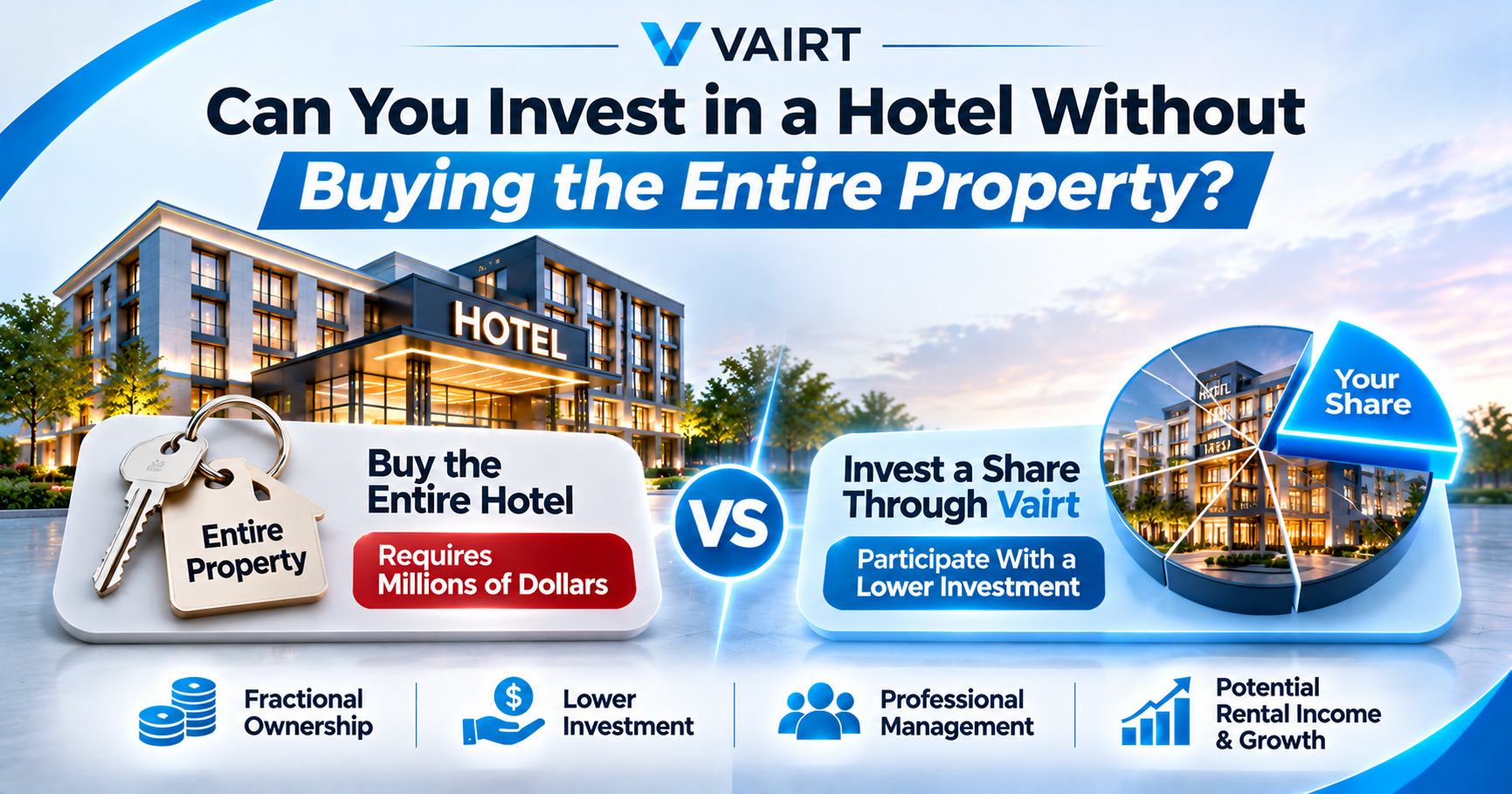
Yes. There are several ways to participate in hospitality real estate without purchasing an entire hotel.
The most appropriate structure depends on how much capital an investor can commit, the level of ownership control desired, and the investment's liquidity requirements.
Fractional hotel ownership allows multiple investors to hold proportional economic interests connected to a particular hotel.
In many structures, investors own interests in a legal entity that holds the underlying property rather than receiving individual ownership deeds for specific hotel rooms.
Their rights to income distributions, voting, and eventual sale proceeds depend on the governing agreements.
This approach can provide access to a particular hospitality property while allowing professional teams to manage its operations.
Investors interested in the legal and financial structure can explore Vairt's guide explaining how to buy shares in a hotel property.
Hotel partnerships allow investors to pool capital for the acquisition, development, or operation of hospitality properties.
A sponsor or operating partner typically manages the investment, while other participants contribute capital under the partnership agreement.
These investments may involve higher minimum contributions, management fees, limited liquidity, and restrictions on investor participation.
Hotel-focused REITs allow individuals to purchase shares in companies that own or finance hospitality properties.
Publicly traded REIT shares may be accessible with substantially less capital than direct hotel ownership.
However, owning REIT shares is different from holding an ownership interest connected to one selected hotel. REIT investors generally have exposure to a company's broader portfolio and are also affected by stock market movements.
Each of these approaches provides different financial rights, risks, and levels of control.
Vairt provides a digital platform for exploring selected professionally managed real estate opportunities in the United States.
Its fractional ownership model is designed for investors who want to participate in specific properties without personally acquiring and operating an entire building.
The process generally involves the following stages.
Investors begin by examining available property opportunities, including information about location, property type, operating strategy, starting investment, and potential income.
Vairt describes a property evaluation process that includes screening and supporting valuation information.
However, investors should still review the available financial documents and conduct their own assessment before committing capital.
Under Vairt's stated model, a funded property is generally held through a dedicated limited liability company (LLC) or similar property-specific entity.
Eligible investors receive proportional ownership interests in that entity according to their contributions and the applicable agreements.
This is different from purchasing a hotel room for personal use or owning the entire property's deed individually.
After selecting a property, prospective investors review the offering documents, complete applicable eligibility requirements, and follow the funding process.
The agreements should clearly explain ownership rights, applicable fees, investment restrictions, income distribution arrangements, and exit conditions.
Once a hotel is operating under the investment arrangement, professional management teams handle daily responsibilities.
These may include reservations, guest services, housekeeping, staffing, building maintenance, and other operational activities.
Investors do not need to personally manage hotel employees or guest bookings.
Vairt describes a model in which owners can monitor property information through its digital platform and may receive monthly distributions when eligible cash flow is available.
The amount actually distributed depends on property performance, expenses, reserves, and the applicable ownership agreement.
Investors can review the broader fractional real estate investment process to understand Vairt's approach to property participation and management.
One hotel opportunity featured by Vairt is Four Points by Sheraton in downtown Peoria, Illinois.
The property is a 323-room hotel operating under the Marriott brand, located at 500 Hamilton Boulevard.
Vairt has published a $25,000 minimum participation amount for the hotel, subject to the offering's requirements and availability.
The property illustrates how fractional ownership can connect eligible investors to an established hospitality asset without requiring them to purchase the entire hotel.
Instead of personally managing hundreds of guest rooms, participating owners rely on the property's professional operating structure.
The property's physical characteristics and operating environment provide several factors for investors to examine, including its location, room inventory, guest demand, operating expenses, and management arrangements.
For investors considering this opportunity, the most important step is reviewing the actual financial assumptions and ownership documentation rather than relying only on the property's brand or projected returns.
Vairt's U.S. hotel investment opportunities page provides additional information about its fractional real estate model and featured opportunities.
Hotel investments can generate income through the operation of hospitality properties, but revenue and investor distributions are not the same thing.
Hotels earn revenue primarily from room bookings. Some properties also generate revenue from restaurants, meeting spaces, events, and additional hospitality services.
Operating expenses must be paid before cash becomes available for other purposes.
These expenses may include employee wages, utilities, property taxes, maintenance, insurance, management fees, financing costs, and necessary reserves.
Under certain fractional ownership arrangements, eligible distributable cash flow may be allocated to investors according to their ownership rights.
Vairt's stated model includes potential monthly rental income distributions for participating owners.
However, monthly distributions are not guaranteed. A hotel's income can change because of occupancy, seasonal travel demand, competition, operating expenses, and broader economic conditions.
Property value may also increase or decrease over time.
Investors should therefore distinguish between projected returns, actual operating income, and cash available for distribution.
Ready to Explore Hotel Ownership Opportunities Starting at $25,000? Schedule a 15-minute meeting with Vairt to discuss fractional hotel ownership and professionally managed U.S. hospitality properties.
Investors may also consider how a hotel's ownership and financing arrangements align with their financial and ethical preferences.
Traditional real estate acquisitions sometimes rely on interest-bearing debt. Other arrangements may use alternative financing or asset-backed participation structures.
Vairt presents interest-free fractional real estate ownership as part of its investment approach, with an emphasis on identifiable assets and documented participation.
However, investors should distinguish between a company's general investment philosophy and the actual terms of a specific offering.
An investment's Shariah compliance depends on factors such as financing arrangements, permitted business activities, contracts, income sources, and the applicable compliance review.
Participation in a real estate asset does not automatically establish that every financial arrangement is Shariah-compliant.
Investors who prioritize these principles should review the relevant documentation and seek qualified guidance where necessary.
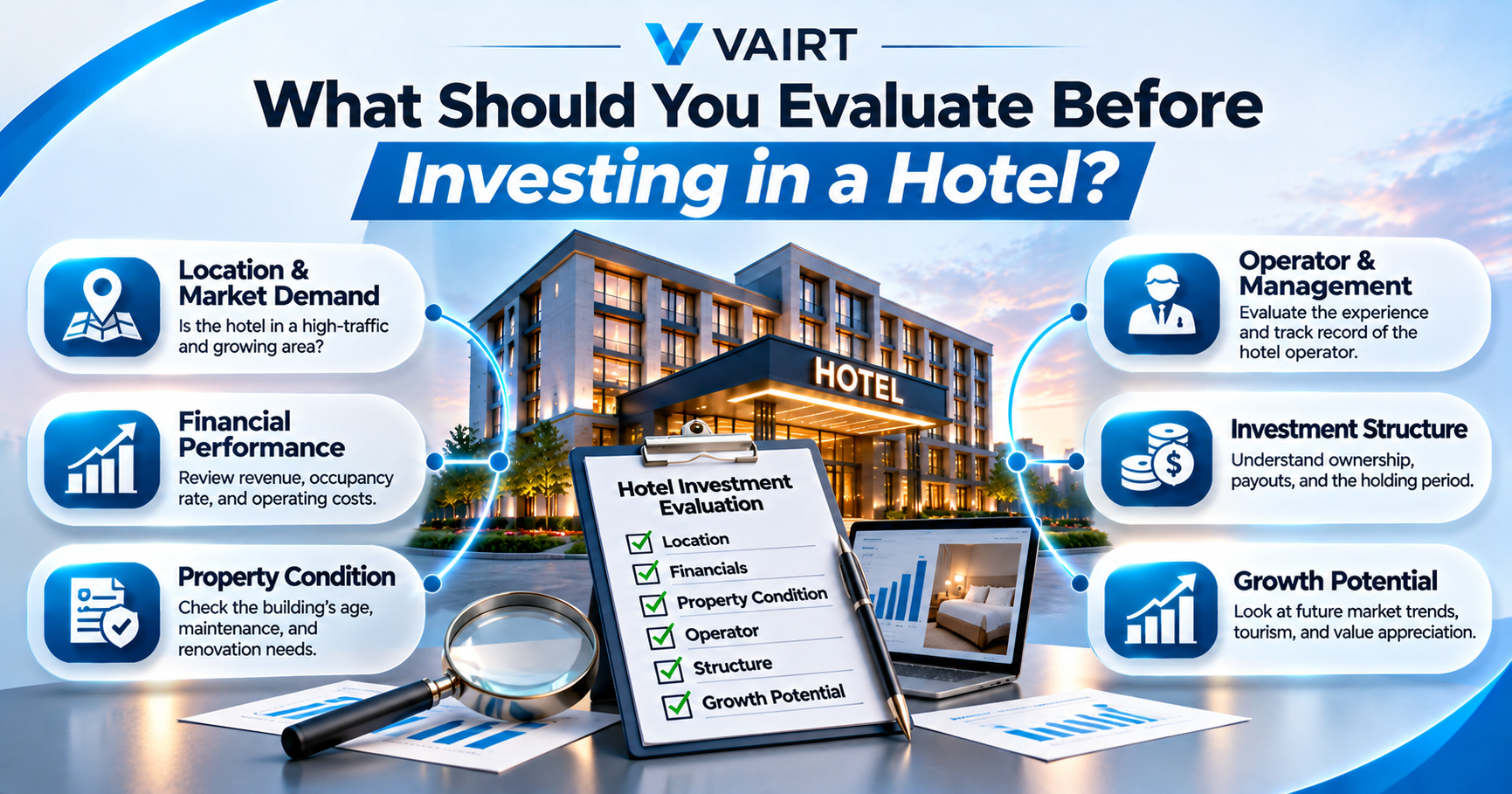
The minimum investment amount is important, but it should not be the only factor influencing a decision.
A hotel with a relatively accessible starting investment may still involve substantial operating, market, and financial risks.
Before evaluating a specific opportunity, consider the following factors.
A hotel's location influences the type and consistency of guest demand.
Business districts, airports, universities, hospitals, and event venues can attract different customer segments.
Investors should understand the property's local market, nearby competition, and historical demand patterns.
Occupancy rates, ADR, RevPAR, operating expenses, and cash flow provide insight into the hotel's financial position.
Historical performance should be reviewed alongside reasonable future assumptions.
Projected income should never be treated as guaranteed profit.
The investment agreement should explain exactly what investors own, how distributions are calculated, what fees apply, and whether participants have voting or other governance rights.
Investors should also understand what happens if the property requires additional capital.
Renovations and property improvements can affect both hotel performance and future expenses.
Investors should examine whether the hotel requires major repairs or upgrades and how those costs will be funded.
For additional background, Vairt's article on things to consider when buying commercial property explains important property evaluation factors.
Private hotel ownership interests may be difficult to sell before the intended holding period ends.
Vairt describes a standard five-year holding period for certain opportunities and potential early liquidity arrangements for eligible participants.
However, exit options depend on the relevant offering terms, available buyers, applicable restrictions, and market conditions.
Investors should not assume they can recover their original capital whenever they choose.
Fractional hotel ownership may appeal to people interested in specific hospitality assets who do not want to purchase and operate an entire hotel.
It may also suit investors who prefer professional property management and are comfortable with a multi-year ownership commitment.
However, it may not suit everyone.
Investors who require immediate access to their capital, complete control over property operations, or guaranteed monthly income should carefully consider whether this type of investment meets their needs.
Ownership participation also involves the possibility of financial loss.
The appropriate decision depends on financial objectives, available capital, risk tolerance, eligibility, and the terms of the particular offering.
You don't need to purchase an entire hotel to begin learning about hospitality real estate ownership.
Understanding fractional ownership, property income, management responsibilities, and investment risks can help investors assess the opportunities available to them.
Vairt's educational webinar, Do You Really Need Millions to Own Income-Producing Hotel Property?, explores the broader concept of hotel ownership and how different participation structures work.
The session provides an opportunity to learn more about hotel investment concepts before reviewing individual opportunities.
Investing in a hotel does not always require millions of dollars.
Although purchasing an entire hospitality property can demand significant capital, fractional ownership, private partnerships, and hotel-focused REITs offer different ways to participate in the sector.
Through Vairt, eligible investors can explore selected U.S. real estate opportunities starting at $25,000, including fractional participation connected to professionally managed hospitality properties.
The important distinction is between purchasing an entire hotel and acquiring an ownership interest in a legal entity associated with a specific property.
Before investing, individuals should carefully review the property's financial information, ownership agreements, projected income, expenses, liquidity restrictions, and potential risks.
Understanding these factors is more important than focusing on the minimum investment amount alone.
Ready to Explore Hotel Ownership Opportunities Starting at $25,000? Schedule a 15-minute meeting with Vairt to discuss fractional hotel ownership and professionally managed U.S. hospitality properties.
No. Buying an entire hotel may require millions of dollars, but fractional ownership and other investment structures can offer different entry points. Vairt advertises selected U.S. real estate opportunities starting at $25,000, subject to offering requirements and eligibility.
Yes, certain fractional ownership opportunities have a $25,000 starting amount. Vairt has published this minimum for selected U.S. hotel properties, including Four Points by Sheraton in Peoria, Illinois. Availability and eligibility must be confirmed before participation.
There is no universal minimum. Publicly traded REIT shares may require relatively little capital, while private partnerships and fractional hotel ownership arrangements set their own investment thresholds.
No. Fractional hotel ownership commonly involves holding an interest in a legal entity that owns the property. It generally does not give investors exclusive ownership or personal use of an individual hotel room.
Typically, professional management teams handle hotel operations, including staffing, reservations, housekeeping, and maintenance. Investors should confirm the management responsibilities stated in the specific ownership agreement.
Some hotel investments may provide income distributions without requiring investors to manage the property's daily operations. However, distributions depend on financial performance and applicable investment terms. Income is never guaranteed.
No. Hotel income depends on occupancy, room rates, operating expenses, market demand, and other factors. Monthly distribution schedules do not guarantee that a particular payment amount will be available.
Potential exit options depend on the ownership agreement, transfer restrictions, buyer availability, and market conditions. Vairt describes certain liquidity arrangements for eligible opportunities, but investors should not assume their interests can always be sold immediately.
Some investment structures are designed around interest-free or Shariah-aligned principles. However, compliance depends on the financing structure, contractual terms, business activities, and other relevant conditions of each offering. Investors should review the specific documentation before making that determination.

I'm Muhammad Waqas, a real estate content writer at Vairt with 8 years of experience writing about property ownership and real estate. I cover topics such as fractional real estate, hotel and commercial property ownership, and how to evaluate income-producing properties. My writing focuses on helping U.S. readers understand how professionally managed real estate works, including its benefits, risks, and structure, before they explore an opportunity.

Certain statements contained in this document constitute forward-looking statements. Such forward-looking statements, including our intended actions and performance objectives, projections, targets, estimates, or forecasts involve known and unknown risks, uncertainties and other important factors, including our ability to successfully develop and operate the Vairt Marketplace, our business model and the services we intend to offer. These factors are based on expectations and assumptions that may change and are subject to regulatory uncertainty, changes in our legal environment and the blockchain and real estate industries generally, which could cause our actual results, performance or achievements to differ materially from any future results, performance or achievements expressed or implied by such forward-looking statements. All amounts, numbers, ranges, and values presented in this document are subject to material change and should be taken as preliminary and indicative only. Any such amounts, numbers, ranges, and values are based upon preliminary estimates, remain subject to ongoing analysis and may change materially. All forward-looking statements in this document speak only as of the date hereof. We expressly disclaim any obligation to update any forward-looking statement to reflect any change in our expectation or any change in events, conditions, assumptions or circumstances.




Comments